
4x💯: Are Dems out of good redistricting moves?
Florida's low-risk gerrymander, Dems favored regardless of new maps, gerontocracy is out, superyachts vs. Senate seats, the politics of energy, build your own median voter, engaged dads
No. 400 | May 1, 2026
It’s the 400th edition of The Intersection! Here’s what was covered in past centennial editions:
No. 100 — December 13, 2019: Blue Wave in the UK — Boris Johnson’s landslide victory
No. 200 — December 17, 2021: Americans prefer suburbs, Democrats’ second post-2020 Latino postmortem
No. 300 — January 19, 2024: Trump’s Iowa victory
Thank you for your support as we chronicle the evolution of data-driven politics. Here’s to the next 100.
🏛️ VRA Section 2 is effectively a dead letter. Are Dems out of good redistricting moves?
The Supreme Court’s long-awaited decision in Callais v. Louisiana has come down. As expected, it renders the Voting Rights Act’s Section 2 a dead letter — but stops short of eliminating it entirely. But the standard of proof is so high that it will do nothing to stop a bonanza of Southern redraws, creating maps that could look something like this:
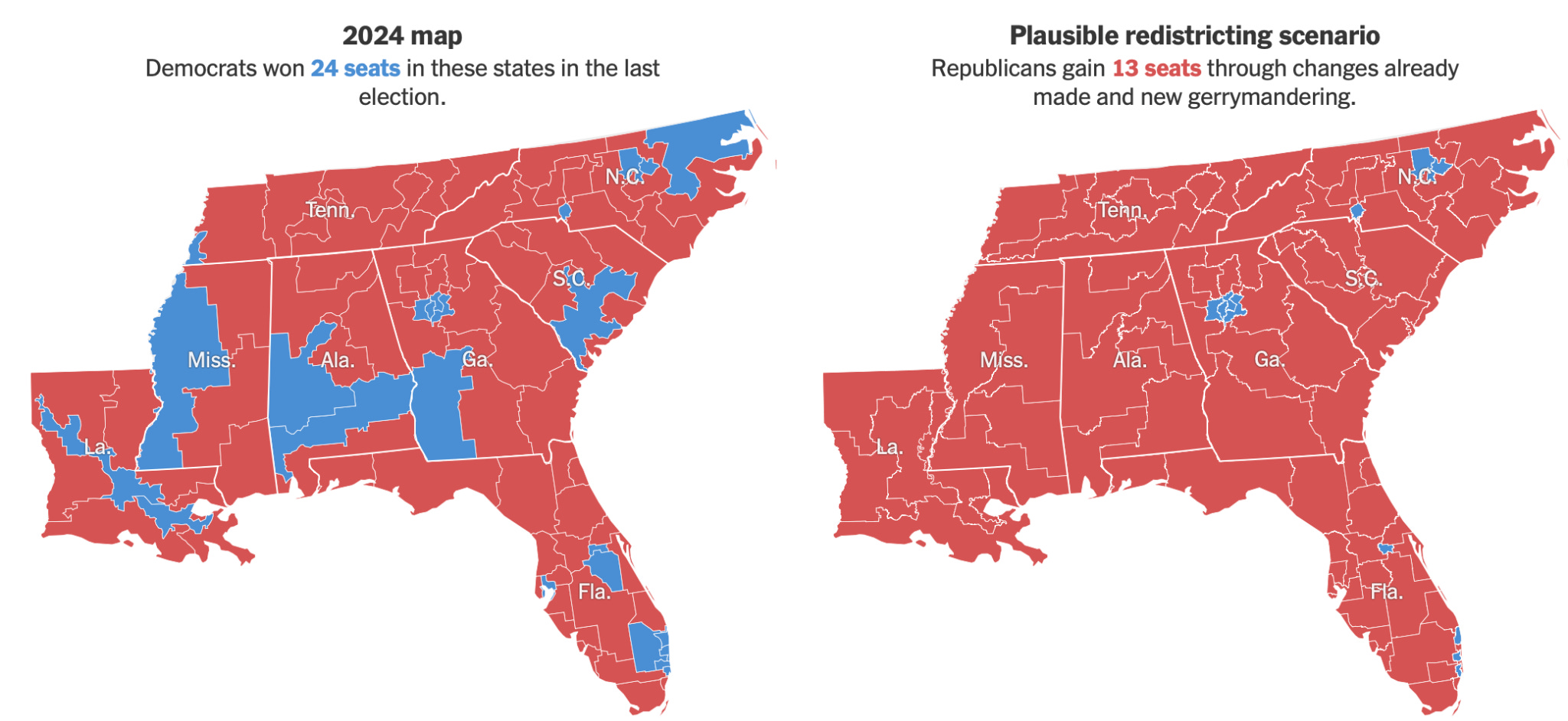
And Democrats could well counter with the following in states that they control, entirely eliminating Republican seats in deep blue states:
Of course, Democrats could try this, especially in states where they can get it done entirely through the legislative process. But here’s why it would be tougher than the current round of redistricting:
Don’t expect the CBC to go quietly into the night. Such a strategy would require eliminating majority-minority districts in the north. Even if current representatives could run in newly redrawn seats, they might not be the best fit for sprawling districts that reach into rural areas. Expect this to be a fight given the interests of very entrenched members in these districts.
Trump held the murder weapon in this round of redistricting. But a Supreme Court decision is different. When Trump went on record urging Texas to create five new Republican seats, that created a pretext for Democrats to respond in kind. His quote was the centerpiece of ads in referendums in California and Virginia. The Callais decision comes down from the Supreme Court — which conveys at least some level of nonpartisan legitimacy. And the Democratic response would need to be even more extreme — entirely eliminating minority party representation not just reducing it — making post-Callais Democratic gerrymanders an even taller ask.
Virginia shows the limits of extreme gerrymandering. The closeness of the Virginia referendum, and the fact that it has exacted a political price during what was supposed to be Abigail Spanberger’s honeymoon period, may have a chilling effect in other states. Already, Indiana Republicans and Maryland Democrats have demurred from joining the current round, showing that some legislatures aren’t willing to pay the political price for what would have been one seat gains.
All norms have been shattered in the current war, and perhaps that will continue. But there are tough practical limits that Democrats would need to overcome that are tougher than the ones they’ve faced in this round.
The Center for Politics breaks down the new Florida gerrymander, which went from 20-8 Trump to 24-4 Trump. A good benchmark for a pro-Democratic year might be 2020, where Biden would have won 8 of the districts under the map. But that’s probably an upper limit: the state has gotten a lot more red in basic partisan terms since then. Even if Republicans didn’t realize all their intended gains in 2026, they would be in a good position to do so in 2028.
Need an expert for your conference or fly-in to break down the midterms or the latest trends in politics, demographics, and AI? Visit my public speaking page or get in touch directly.
🗳️ The House overall still leans Dem, redistricting or not
Regardless of what further redistricting moves might get made, the House still leans pretty solidly Democratic regardless of any further redistricting moves. And the main reason behind that is Trump’s approval rating. A Bruce Mehlman chart shows it hanging out on the bottom end of the range. A true 50-seat collapse is not in the cards given how fortified the current districts are, but any GOP recovery means some sort of bounce in Trump’s ratings.
🧓 Gerontocracy is over, at least among Dem Senate candidates
Striking chart from Nate Silver showing the slate of Democratic senate candidates is a median of 17.5 years younger than in 2018 with 63% of the candidates being under 50 years old. The youthful shift may be partially explained by there being more Democratic challengers than incumbents in the running. But the story lines up pretty strongly with the flameout of Janet Mills in the Maine Senate race.
The shift towards youth is at least a little bit of a gamble. Two of their elder statesmen, Roy Cooper and Sherrod Brown, are probably the best possible candidates Democrats can run in their respective states. And younger Democratic candidates who came up in the Peak Woke era have thick oppo research books, specifically Graham Platner, Mallory McMorrow, and Abdul El-Sayed. Each of these candidates cast some doubt on whether Democrats can convert what should be easy wins.
At the same time: Democrats appeared to be taking a chance on youth with Zohran Mamdani, and he hasn’t quite proven to be the albatross people were expecting.
💰 Buying a superyacht is easy. Buying a Senate seat is hard.
Millionaires that fund their own campaigns rarely make a successful return on their investment with only 10 of 65 prevailing in 2024. That hasn’t stopped more from trying this year as it raises national profiles and past efforts helped 3 failed Republican millionaire candidates land positions in the Trump administration. This shows you why Democrats are still shopping around with Tom Steyer obliterating his Democratic rivals in campaign spending.
⚡ The politics of energy
UK men are 44 points more supportive of the use of nuclear energy than UK women, a trend that’s a particularly extreme version of what we see in the U.S., where questions that serve as a rough proxy for risk also see huge gender gaps.
A NYT dataviz masterclass this week with all the charts you might conceivably need to visualize the coming energy shortage. Ironically, it’s advances in nuclear that have the most potential to solve this — if they can overcome longstanding voter resistance.
🛹 High school cliques visualized
David Shor polled the high school cliques people were in. I asked Claude to visualize this as a class of 100 students.
🧬 Build your own median voter
An AI browser application allows you put in a combination of demographic, identity and location traits it refers to as voter DNA to estimate your precise likelihood of aligning with one political party over the other.
👫 Today’s dads do twice the childcare
Fathers are spending twice as much time on childcare and have generally increased their involvement in caring for the family and home compared to 50 years ago. Mostly that’s replaced time at work and free time. Dads also report being happier than
🚜 Farm Country is best for cost of living
This map graphs how much income a median family of 4 keeps after taxes and necessary expenses. The percentage varies widely from a high of 34.7% in Iowa to a low of 9.0% in Hawaii.


