


No. 423 | November 6, 2026
Not just a wave or tsunami, but a deluge
Waves wash in and then wash back out just as quickly. This oft-chosen metaphor doesn’t do justice to what happened on Tuesday. The entire edifice of Republican governance in some of their reddest strongholds will remain underwater for some time. Even if it’s just for an election cycle or two, the loss of Texas is a political shift with the Obama or Trump elections that we’ll probably be talking about for a generation. It will be difficult for the party to come back in Congress until 2030 or 2032.
The election result itself revealed a failure of imagination in the pundit and forecasting class about how sweeping the blue wave could be. Once again, analysts were directionally right about where things were likely going but underestimated the magnitude of the shift. The snapback when it comes could be just as disruptive and unexpected. The lesson: if a trajectory seems clear, take the over on how far it will go.
Nothing is permanent in politics and the pendulum will swing back. Both parties have agency in how that unfolds, and for Republicans, that starts with taking the right lessons from the defeat.
Ignoring the voters who elected you is generally a bad political strategy
Donald Trump was elected by a multi-racial coalition with a mandate to restore economic confidence and bring the cost of living under control. Covid broke the country’s economic optimism, among many other things that remain broken. Still, Donald Trump was viewed as a better steward of the economy in 2020, and his first election actually led to a surge of economic confidence.
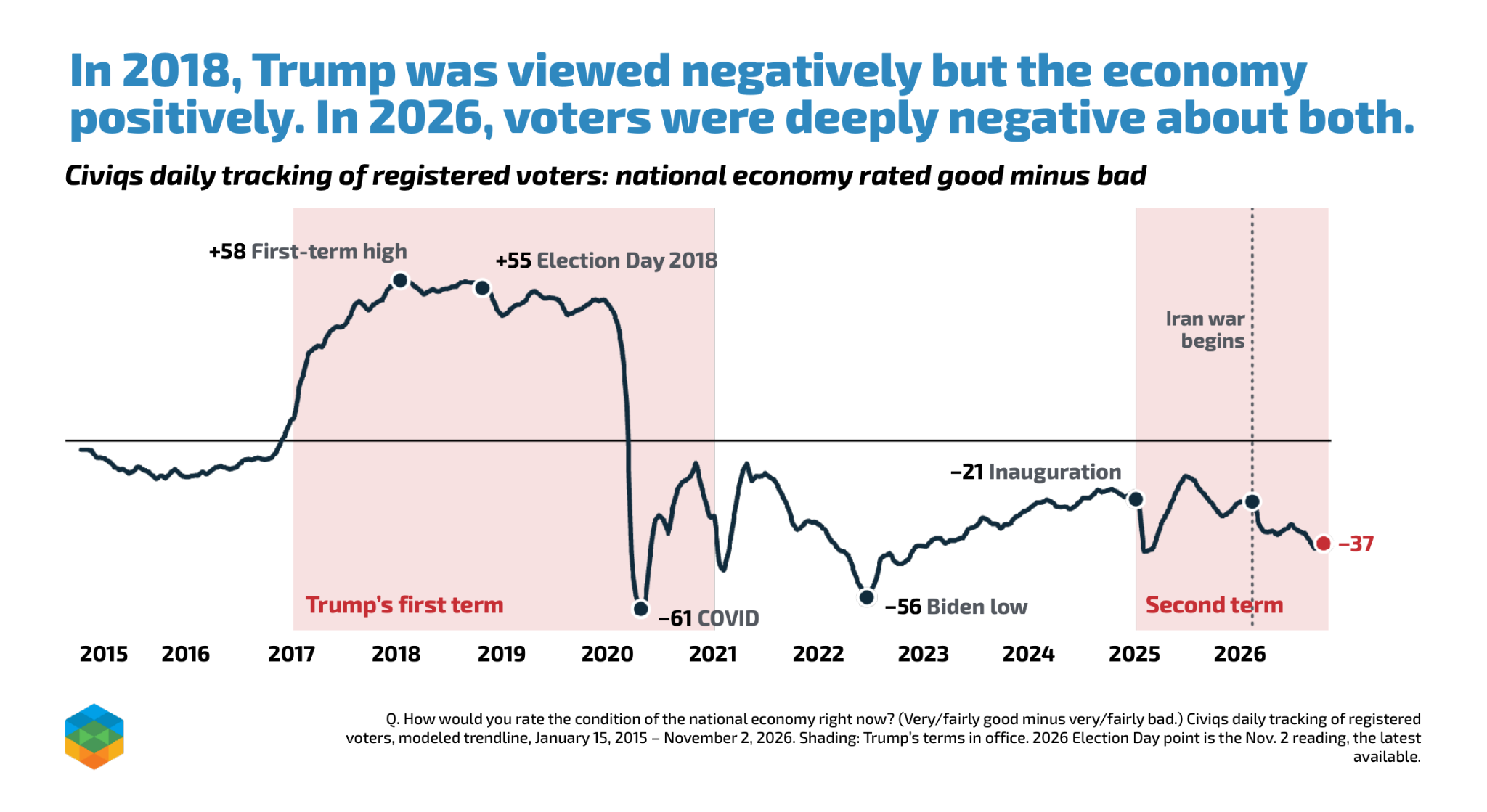
In 2024, there was hope he could do it again. Instead, economic confidence quickly stalled and then reversed. The Iran war made it worse.
The very voters who elected Trump — Hispanics, working class voters, young men — were the ones who felt cost of living pressure the worst. The very same groups snapped back or strayed home on Tuesday.
Trump was content to have their support and on taking office did much to deal with the problem of greatest interest to him personally and to the pre-2024 version of his coalition: immigration and border security. But something changed between Trump 1.0 and 2.0, the country’s main economic concerns shifted from the ones that Trump the outsider businessman was strongest on, jobs and stock market growth, to cost of living concerns neither party had ready answers to.
Democrats lost in 2024 because they seemed to have no answers. And Republicans lost in 2026 because they didn’t seem to have answers either. Expect the swings back and forth to continue until someone can convincingly articulate a plan to stabilize costs. For 2028, though, the risk is still greatest for Republicans, since they still control the White House.
There was a difference in 2026, though. Trump didn’t merely govern in a period of high voter discontent — a more or less permanent feature of politics over the last 20- years — but did the very thing voters blame for making the problem worse, launching a war that drove up the most visible cost of them all. That turned out to be the difference between a wave and a wipeout.
The coming factional battle will badly miss the point
There will be much jockeying in the wake of this defeat to settle ideological scores. The populist right can blame the war and be right. The traditional right can blame tariffs and be right. But neither of these on its own gets at why voters thought either of these things was such a problem, which is the impact on their daily costs.
If you’re the kind of person who’s really animated by an America First foreign policy, this election is a great opportunity to advance your preferred agenda. But it mostly misses the point about what the voters who decided this election are interested in. Here are the Trump voters who now disapprove of him in their own words:
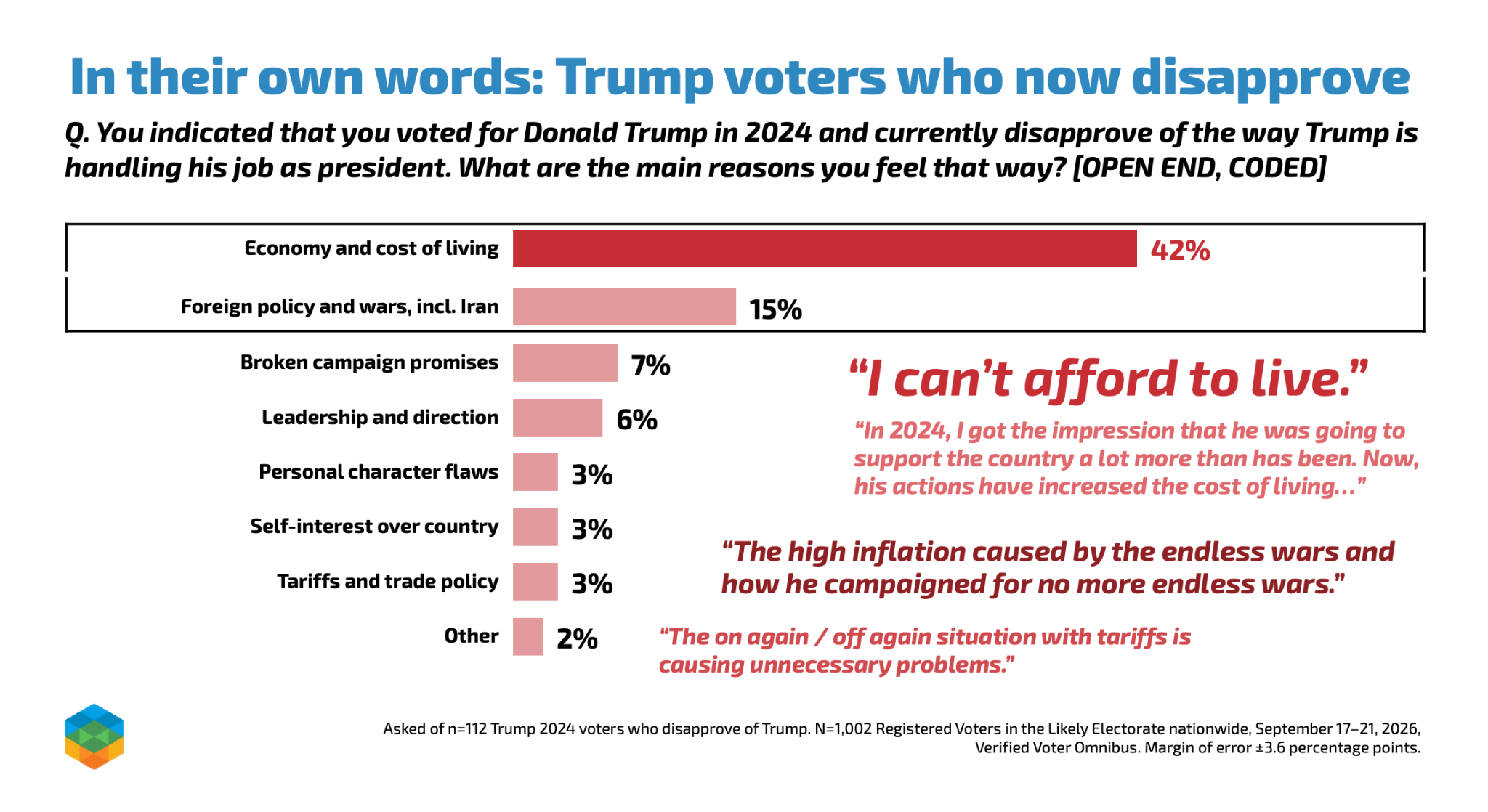
For sure, a segment of the young right is interested in curtailing America’s involvement in foreign wars, and this shows up as the second most frequent response when interviewing Trump defectors. But this is outweighted nearly 3-to-1 by purely economic concerns. If that’s not your primary motivator, if you’re not giving off a monomaniacal Carvillian obsession with the economy as the number one issue, you will lose the thread, and probably the election too.
The election shows Republican voters have already moved off Trump
President Trump asked Republicans to vote as if he were on the ballot. Many of them didn’t vote at all. Republican turnout was atrocious throughout the country — except in Ron DeSantis’s Florida. Here was the situation in Texas:
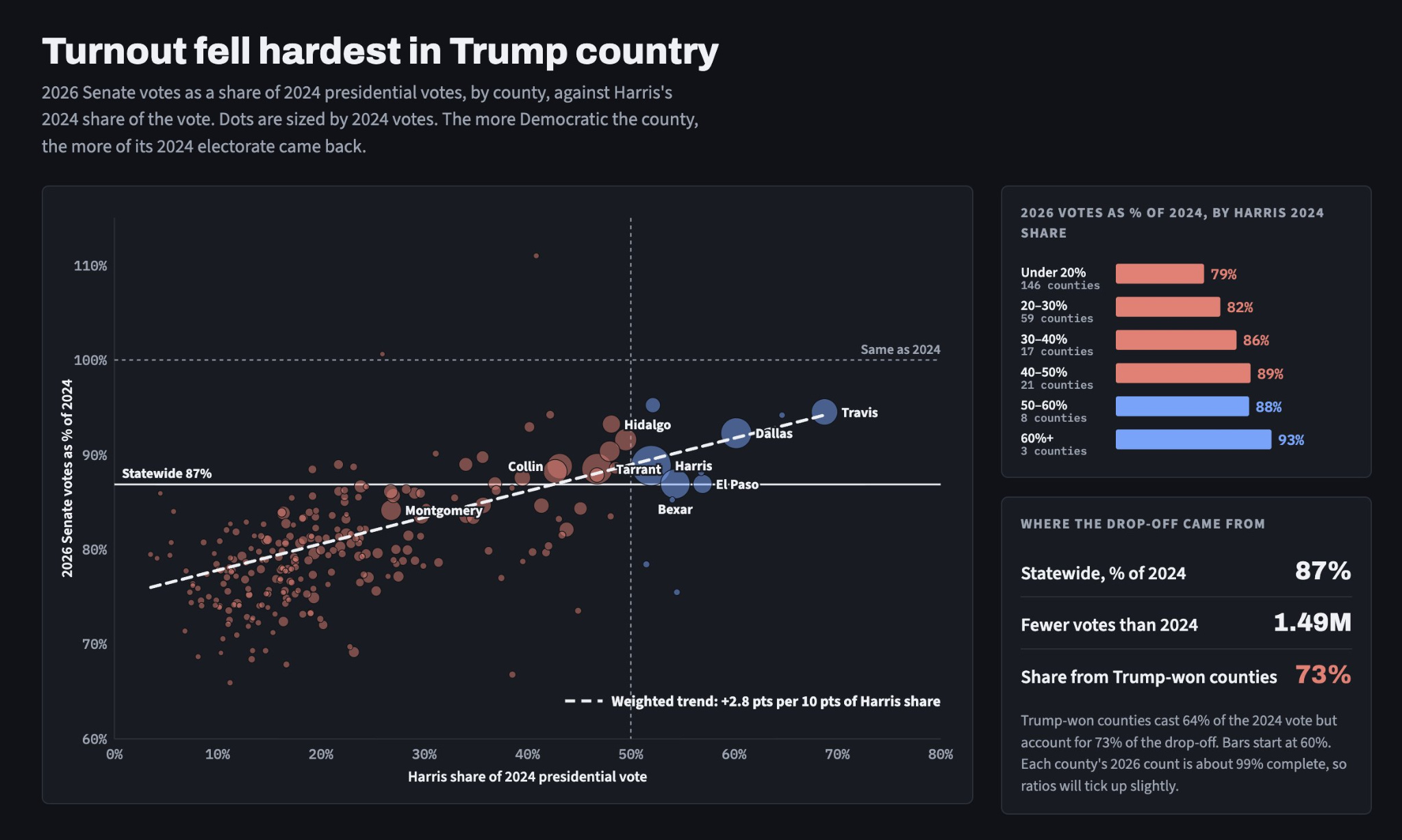
This is not what we saw in 2018, and it signals a growing disinterest among many Republican voters in the Trump political project that’s been brewing for a while now. If the first term was marked by partisan and news media attacks questioning Trump’s legitimacy, that was always going to keep Republican turnout from falling below a certain level, even on the worst days. And to a certain extent, Trump himself running for re-election in 2020 and 2024 gave Republicans a strong incentive to fall in line. The times when Trump was actively running for president was when the emotional stake in his success grew.
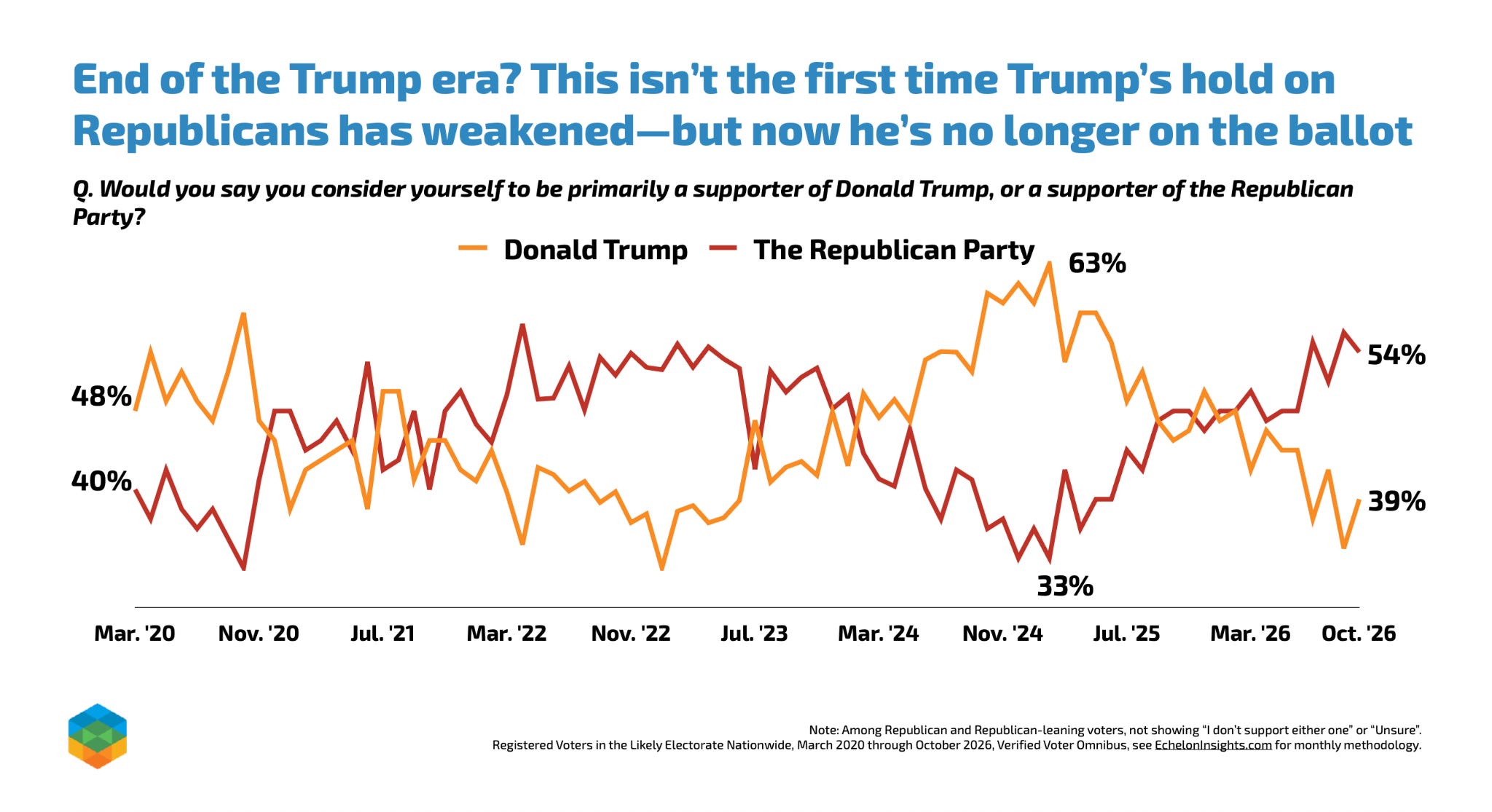
Trump can no longer run for president. Republicans know it. At some level, voters need something to turn out for. For many Republicans, slightly better prospects for a lame-duck Trump presidency isn’t a compelling enough reason. Absent that, Republicans needed a unifying story for what to turn out against, but they didn’t have that either, nor anything remotely relevant to say about the economy. The result is a blue Texas, Democratic senators from the Deep South blocking the path to any quick return to power in Congress, and an uncertain path to 2028.