
Democratic voters support democratic socialism 3-to-1
Young voters and antisemitism, the New Entrant GOP, the Mississippi miracle, SCOTUS poised to end coordination limits, AI progress, trust in government, the rise of "cord-nevers"
No. 384 | December 11th, 2025
đŹ Democratic voters support democratic socialism 3-to-1
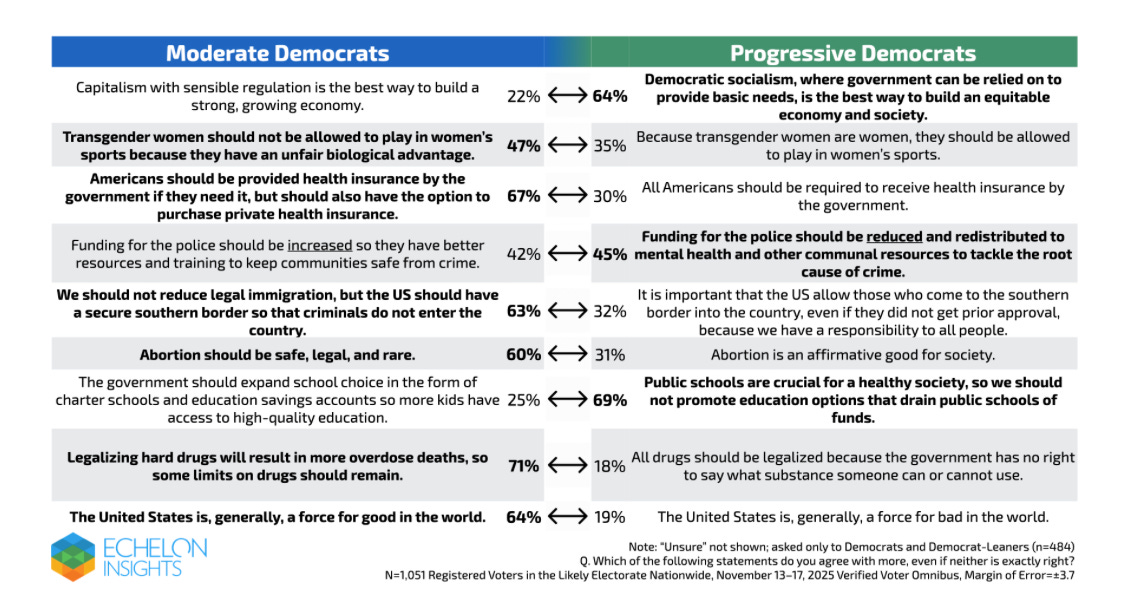
We asked self-identified Democrats about nine pressing issues in our recent omnibus survey monthâs omnibus survey. While they sided with the moderate view on six of those issues, one view stands out: a 3-to-1 preference for âdemocratic socialism, where the government can be relied on to provide basic needs,â over âcapitalism with sensible regulation.â
Note that itâs not just young Democrats either. Older Democrats supported this position by a net of 25 points, while their under-50 counterparts supported it by a staggering 67 points.
Even nominal support for capitalism is virtually nonexistent among younger Democrats.
đźđ± Young voters on Israel and antisemitism
While views more critical of Israel in the Gaza conflict are more common on the political left than the right, the Yale Youth Poll finds that distinctly antisemitic views are more common on the conservative fringe.
Young voters overall are more likely to agree with antisemitic statements.
đ Conspiracism and the âNew Entrantâ GOP
Iâve increasingly argued that the right lens through which to view the voters who moved into the GOP in 2024 is not greater diversity, but lower voting propensity, which is inexorably tied to age.
While Trumpâs 2020 gains with Hispanics and Asians appear safe for now, Democrats in recent elections have been able to roll back a good bit of Trumpâs 2024 gain â through a combination of turnout and persuasion. These gains were concentrated among younger voters at the fringes of the economy who are less politically engaged. If the âfirst waveâ of gains were among culturally conservative denizens of places like South Texas or Little Havana, the âsecond waveâ was concentrated among young men heavily into the podcast scene.
The Manhattan Instituteâs recent survey digs into this divide further, dividing the GOP into a âcoreâ voter and a ânew entrantâ voter. The new entrant voter is more skeptical of political figures (including those on the right) overall â and more into conspiracy theories. As authors Jesse Arm and Matthew Knee write,
A stark divide emerges between newer and long-standing Republicans: 34% of New Entrant Republican voters believe most or all of the theories, compared with 11% of Core Republicans. Put another way: 63% of the highest-conspiracy believers previously voted for Obama, Clinton, or Biden at least once since 2008. (emphasis added)
This is a tension Republicans will need to navigate. Any party that simply writes off new entrants because they hold some objectionable views will consign that party to permanent minority status.
đŹ Why the Mississippi Miracle is likely real
The debate over the Mississippi Miracle â where the state jumped from 49th to 9th in reading â provides lessons about negativity bias and survivorship bias in data analysis.
Youâve probably seen this picture before. Itâs a diagram where World War II planes were hit by enemy fire, which was supposedly used to guide crews on where to reinforce the planesâ armor. The problem was that the conclusions are exactly the opposite of what the image implies at first glance, because these were the planes that survived. You actually need to reinforce the empty spots, not the red dots.
A viral critique of the Mississippi Miracle suggests that it all comes down to survivorship bias. Mississippi held back 3rd grade students who were behind in reading, lifting the average. Thatâs the nexus of negativity bias and survivorship bias: policy change never shows so dramatic an effect, so it must be due to a change in the composition of the sample.
Writing in The Argument, Kelsey Piper finds that this wasnât actually the case. Reading levels increased at all levels, not just for those at the bottom. The students who were held back eventually took the test; they arenât excluded from the statistics entirely, as the authors misleadingly imply. The one off policy change on third grade retention happened in the middle of a 20-year stretch of steadily improving scores, and there was no detectable change as a result of the sudden shift (as a difference-in-difference analysis might show). The miracle appears to be real.
đșđČ SCOTUS seems poised to end coordination limits
In what would be a major shakeup of campaign finance laws, the Supreme Court on Tuesday heard oral arguments in NRSC v. FEC, a case initially brought in part by JD Vance challenging coordination limits on political party spending on federal campaigns. The odds are that the conservative majority will reverse a previous 5-4 decision from 2001 limiting how much party committees could spend on campaigns in coordination with candidates.
Party committees can currently spend in unlimited amounts â through independent expenditure units that donât talk to the rest of the committee or the campaigns. Reversing these limits would render these IE units obsolete, and allow committees to buy advertising at more favorable rates usually only reserved for candidates. It could also significantly reverse the decline of the political parties that happened after the Citizens United decision opened the floodgates to unlimited SuperPAC spending in 2010.
đ€ This week in AI acceleration
As I was playing around with ChatGPT 5.2 this morning, I was reminded by just how much more often Iâm left with the thought, âHoly crap, this actually works.â
After the sheer novelty had worn off, it was easy to be left under-impressed by the initial release of ChatGPT in November 2022, or by the state of AI coding models a year or six months ago that would leave you spinning your wheels after a while.
Early AI wasnât just a âminimum viable product.â There was real doubt as to whether it would actually work, whether it would produce not just acceptable human-quality work, but actually good work, or whether it could actually build that slide deck for you.
With Nano Banana Pro from Google, we are seeing glimpses of the overthrow of PowerPoint.
In the geospatial field, you can turn one prompt into an interactive map that used to require an expert. You can also type the words âsand trapâ or âhouseâ into satellite imagery, and it will find all the sand traps and houses automatically.
đïž A new way to think about trust in government
Karlyn Bowman argues that instead of the government generally or elected officials specifically, pollsters should instead look at how the American public feels about specific government functions and agencies to gauge how best to repair a public trust that has been eroding since the 1960s.
đș Up to 50% of off-year voters only used streaming services
A survey by the Center for Campaign Innovation finds that 50% of Virginians and 40% of New Jerseyans use only streaming services for live content, with many never watching live TV at all, requiring campaigns to adapt their strategy to these âcord never,â disengaged voters.


I wouldn't categorize the theory that COVID-19 escaped from the Wuhan lab as a conspiracy anymore.
I would also like to see the same breakdown of conspiracy theory belief for Democrats and Independents.
How could striking down campaign coordination significantly reverse the decline of the political parties that happened after the Citizens United?