
How to avoid a midterm blowout
A hopefully less Simon Rosenberg-esque take.
The Virginia redistricting referendum is in the books and, as expected, Democrats have succeeded in passing their 10-1 map, albeit by an underwhelming 3-4 point margin. That performance stands in stark contrast to their frothy performances in recent special elections.
I want to focus less on the margin than the turnout, which was not only well to the right of 2025, but also 2024 and maybe even 2021—when Republicans won.
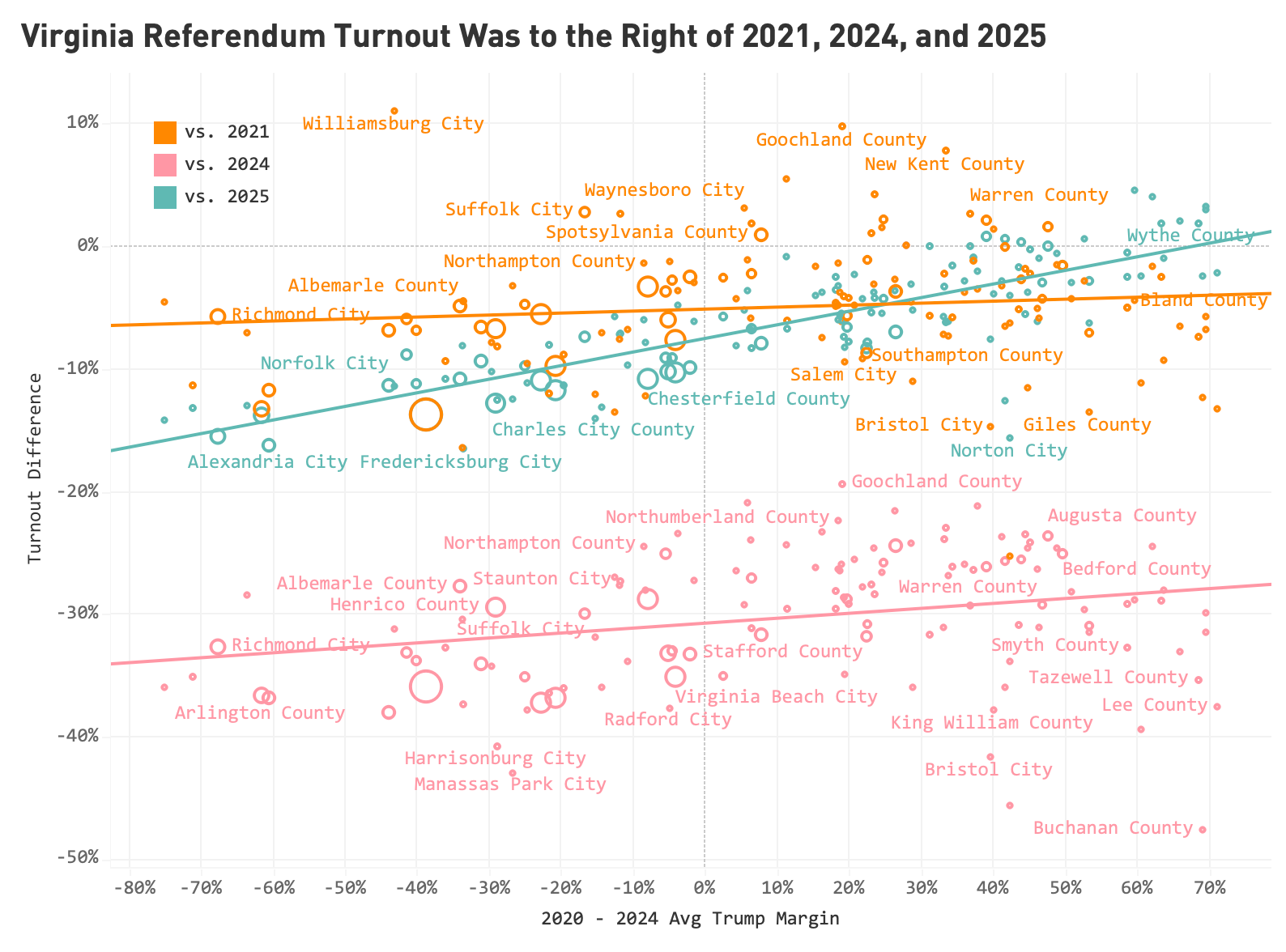
Republicans obviously didn’t succeed in defeating the referendum, but it showed that the fight was winnable, and more money invested early might have made a difference.
Absent a victory, Virginia provides Republicans with a rare optimistic counterpoint to the building narrative of a Blue Wave. If the fight is framed the right way, Republican voters will turn out the same or better relative to Democrats than 2024, even with an unpopular president in the White House. And if they recreate this performance even to some degree, they are virtually assured control of the U.S. Senate and will hold their own in the House, with a fighting chance to keep their majority.
Virginia and the recent special elections tell the same story
The turnouts in Virginia and the other special elections appear to contradict each other, but they actually tell the same story: nothing motivates turnout like threats to your partisan identity.
Democrats have been turning out all cycle because they’re virtually powerless in Washington and winning more Congressional seats is the only hope they have of slowing down the Trump White House. Meanwhile, Republicans have been watching contentedly from the sidelines as Trump moves more assertively to reshape the American political order than he did in his first term.
Early in 2025, this storyline of Democrats reeling and in disarray gave Republicans hope that 2026 would go better for them than 2018. But ironically, what appeared like weakness has turned into a Democratic superpower. A Democratic Party that appears weak and powerless made it easier for Republican voters to fall asleep. Meanwhile, Democrats remain as eager as ever to crawl on glass to stop Trump.
Echelon polling reveals this asymmetry across both parties. 82% of Democrats say it’s extremely important for their party to take control of Congress to stop Trump from carrying out his agenda. Just 55% of Republicans say the same about keeping control of Congress to help Trump carry out his agenda. While a majority of Republicans say that Trump will mostly be blocked from enacting his agenda if Democrats win the midterms, fully 38% say that Trump will still mostly be able to carry out his agenda.
Among Republican voters, there’s no palpable sense that the midterms really matter, because so much of what they can see with their own eyes and ears tells them it doesn’t. Trump dominates politics and is able to move forward on many of his priorities even disregarding his own majority in Congress. The threat of impeachment isn’t really a threat — it was tried twice before, and there are never going to be the votes in the Senate to convict.
In a bad political environment, Virginia was a controlled experiment in what could happen if you could conjure up a credible threat to Republican voters: an assertive Democratic state trifecta moving swiftly to steal four of the party’s Congressional districts. And Republicans turned out in 2021 numbers to stop this, though this obviously wasn’t enough.
But there is a lesson for the midterms. Republicans beating the spread has less to do with coming up with better defenses of Trump’s policies than it does with getting Republican voters off the sidelines by convincing them that giving Democrats power is really a threat.
Redistricting helps the defenders
We do have a somewhat decent example of an incumbent party beating the spread in a midterm — 2022.
Mechanically, what we saw happen in real time was the Dobbs decision move polls and primary voting from a 6-7 point Democratic deficit to a 2-3 point deficit. This was still not enough for an outright Democratic win, but it did get some low-propensity Democrats off the sidelines to prevent a complete wipeout. This and January 6th changed the narrative on who the most threatening and powerful actors in American politics were from the Biden Administration to Trump and MAGA.
The mythology around this ended up being so strong that Democrats decided to run it back in 2024, to disastrous effect: leading Biden to run for re-election and trapping Democrats into an issue set with no appeal to the swing electorate.
Something else happened in 2022 that was equally consequential: it was a redistricting cycle. That year, both parties worked to redraw maps to take swing seats off the board. More money chasing fewer seats meant a greater ability for the parties to create their desired political environments in these districts, one different from the national environments. So, while the national vote still indicated a good Republican year, this didn’t really show up in swing seats because Democrats were able to spend to defend them.
As a general rule, more spending will tend to push races back to the partisan baseline by bringing out the low-hanging fruit voter: one who will reliably vote for the incumbent party but is currently under-motivated by the incumbent’s bad approvals. The math here is simple: a good political environment maxes the attacking party out on turnout, something we see most prominently in special elections, but the flip side is more opportunities for the defending party to rile up their mid-propensity partisans.
The current mid-decade redistricting cycle further narrows the playing field of competitive districts. Beyond wherever the exact breakdown of gains and losses ends up at, the sorting of Congressional districts structurally benefits the incumbent party by allowing them to defend fewer seats with more financial resources.
Good vibes—and their limits
Before Virginia, I had a tweet that summarized the positive Republican case, one that Josh Barro likened to the Simon Rosenberg hopium case on my recent appearance on Central Air.
Much of this scenario admittedly rests on the ability to create good vibes, something that our body politic seems to have developed an allergy to. It also depends on Trump himself not getting in the way of them—oftentimes a tall order.
But in many ways, the bar Republicans need to clear is fairly low. The median state in the Senate voted for Trump by double digits. Just motivating core Republican voters to get off the sidelines should be enough to win those races. Anything in the service of that helps.
Good vibes alone won’t do it, though. The larger part I didn’t cover in that particular tweet is that the GOP needs to deploy a credible contrast message with the Democrats, one that shows their voters that they’re a threat, just like they were in Virginia. That could be around border security, deportations of criminal illegal aliens, or showing how their policies would increase costs for the average American—making the case that this was exactly what happened when they were last in power.
That’s actually a more Trumpian approach than just trying to sand the rough edges off by simply talking more about the cost of living or going after the pharmaceutical industry or banning Congressional stock trading. These ideas might poll well, but the Biden team fell into this trap. You can do what you think are good things, but good luck getting voters to believe you’ve done them or that they’ll have any impact on their daily lives.
The more plausible path is negatively defining the Democrats—the kind of scorched earth campaign that Trump enjoys and knows how to run.
I’ll acknowledge there are very real and practical obstacles to an approach like this succeeding. It’s unlikely we’ll get something on the order of the Dobbs decision that makes Trump not the main character. But if you think that Republicans are polling pretty close to a floor right now, there are pretty clear ways to at least marginally improve that situation that don’t involve somehow convincing people that the cost of living is no longer a problem. In Virginia, we saw glimmers of how that could play out.


Excellent analysis: "Among Republican voters, there’s no palpable sense that the midterms really matter, because so much of what they can see with their own eyes and ears tells them it doesn’t. Trump dominates politics and is able to move forward on many of his priorities even disregarding his own majority in Congress. The threat of impeachment isn’t really a threat — it was tried twice before, and there are never going to be the votes in the Senate to convict.