
The 2026 models are here
Max gerrymandering, Americans like Big Tech, hard data on unlikely voters, common ground still exists, endorsements matter, the rise of involved fathers
No. 405 | June 19, 2026
🇺🇲 Split Ticket’s new House model
Split Ticket’s model for The Argument finds Democrats with a strong advantage in the House (86% chance of majority) but Republicans favored in the Senate (56%).
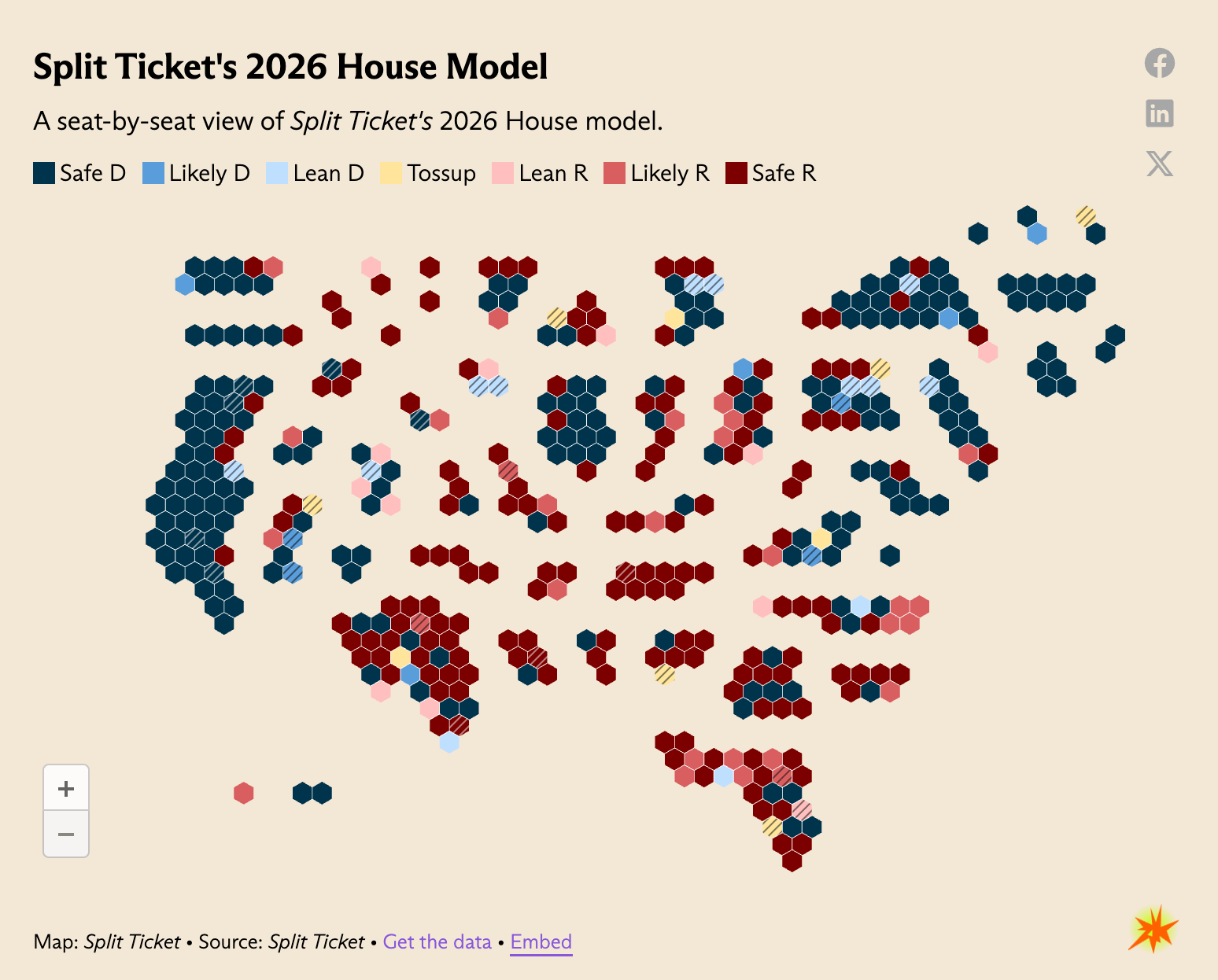
Rather than opining extensively on this model specifically, I’d recommend you have a listen to Split Ticket’s Lakshya Jain and VoteHub’s Zachary Donnini on the GD Politics podcast.
In 2024, I wrote about the “dealer’s choice” problem of forecasting: the assumptions baked into them by the forecaster can move the results more than the underlying distribution of the data contained within them. This is inevitable, and I think both Lakshya and Zachary are honest about the choices they’ve made. There are assumptions in either or both about how the election will move from now until Election Day and whether the races will be closer in battlegrounds than in non-battlegrounds. And both are subject to small-n problems — you can make the case for either from past elections, but there just aren’t that many past elections to go off of. In my view, the evidence is not as strong for midterms closing in the direction of the challenger party: this definitely wasn’t the case in 2022 and the RCP average on this date in 2018 mirrored the final averages. But overall, these are solid entries into 2026’s modeling sweepstakes.
🗺 The limits of gerrymandering
Nathaniel Rakich asks what would happen if both parties fully maximized their gerrymandering powers, finding that neither side is likely to create a permanent House majority. The result would be just 17 competitive districts.
I’m still interested in the thought experiment of how close to zero you can get competitive seats and where the House would shake out in that scenario — even if that’s not maximally good for one party in any given state.
📊 Americans still like Big Tech
Prominent progressives like Alexandria Ocasio-Cortez and Bernie Sanders have become increasingly critical of the tech sector, but that rhetoric appears disconnected from public opinion. In The Argument’s most recent national survey, a majority of Americans held favorable views of Google, Amazon, Microsoft, and Apple.
My position on AI is pretty clear: I’m not an AI doomer—even as Americans hold more negative views about AI than mainstream tech. But just as with tech, I wonder if we’ll get the reasons for the tech backlash all wrong. For tech, it wasn’t data privacy, but its effects on children and stunting social interaction. And with AI, it won’t be the jobs—but taking the social ill effects of phones even further. Already, Americans now spend roughly twice as much time chatting with AI companions as they do on dating and social discovery apps. What happens when AI becomes a more compelling substitute for talking to another human being than doomscrolling social media is today?
📊 Charles Franklin re-runs the unlikely voter data
A thank you to Charles Franklin for reading my piece last week and re-running cuts of the unlikely voter universes I was only able to infer from Marquette polling releases. Unlikely voters are generally more pessimistic about the current direction of the country and are much less partisan. Disapproval of Trump doesn’t translate as easily into support for Democrats in the same way it does for likely voters. These numbers are important to understand if you’re evaluating the differences between surveys of likely voters, registered voters, and surveys of all adults.
Charles Franklin reran the Marquette data with new cuts of the electorate, confirming that unlikely voters are a distinct group: less engaged, more independent, less partisan, and more negative about the country’s direction than adults, registered voters, and likely voters.
📊 Common ground still exists
A new AEI survey finds that Americans still broadly agree on many core civic values, including free speech, religious liberty, and equal opportunity, even as confidence in institutions has declined. One of the biggest divides is generational, as younger Americans are less likely to express pride in the country.
🇺🇲 The endorsement advantage
VoteHub’s 2026 Endorsement Tracker reveals that endorsements could matter more in lower-information elections like congressional primaries. Candidates who capture a larger share of available endorsements tend to perform better, though the effect appears stronger among Republicans.
🇺🇲 Republicans mention Trump in their ads more than Democrats
Wesleyan Media Project’s update on midterm advertisements finds that Trump is commonly mentioned in midterm ads — and is mentioned more by Republicans than Democrats. That’s a function of the primary season, but one wonders what the knock-on effect of this will be in the general election.
👫 The rise of the involved father
New data from Lyman Stone shows how dramatically fatherhood has changed over the past generation. Married dads of young children went from contributing fewer than 10 hours a week of child care and household work in 1965 to nearly 30 hours a week in 2024 — roughly a 300% increase.
👫 Orthodox religions could be a much bigger deal in the future
Ryan Girdusky looks at how fastest-growing religious communities, especially Amish and Hasidic Jews, could wield outsized political influence over the coming decades as their populations expand far faster than the national average.


