
The Democrats' identity crisis
The 26 seats that will decide, signals flashing red, Texas isn’t done yet, AI brain fry, Americans are uniquely judgy, views of data centers, GeoGuessr for politics
No. 394 | March 13, 2026
🫏 The Democratic Party’s moderates are hiding in plain sight
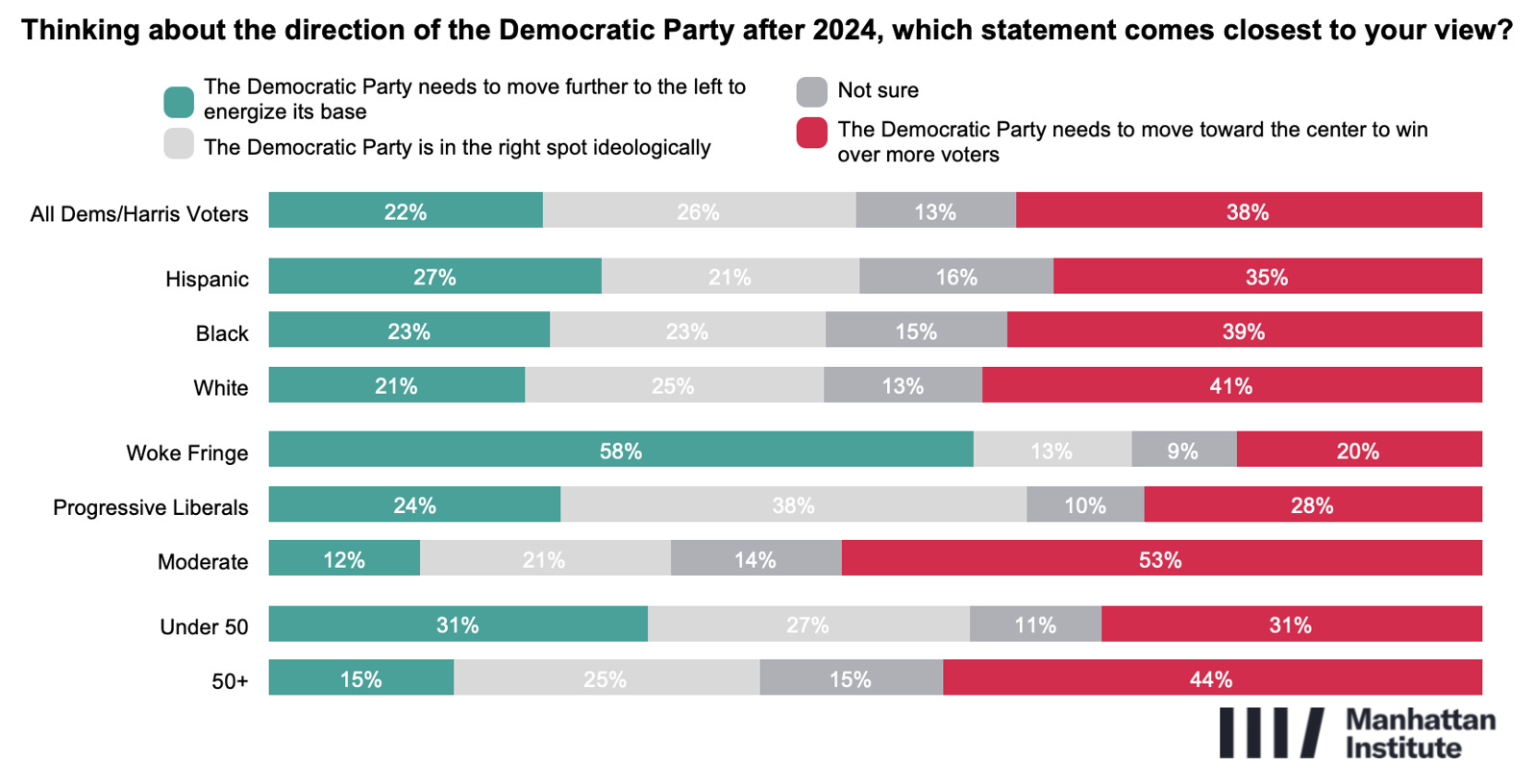
A new Manhattan Institute survey of nearly 2,600 Democratic voters finds a coalition that’s far more moderate than its loudest voices suggest. The party breaks into three blocs: Moderates (47%), Progressive Liberals (37%), and a “Woke Fringe” (11%) that takes consistently maximalist positions. Just 22% want the party to move further left while 38% want it to move toward the center. On issue after issue — immigration, trans policy, DEI, crime — the median Democrat looks nothing like the activist left that dominates the discourse.
🗳️ The 26 seats that will decide the House
DecisionDeskHQ has mapped out the 26 Republican-held districts most likely to flip in November. Five are seats Harris carried in 2024, but the main battlegrounds will be the 11 seats that Trump carried by 5 points or less. (And yes, this is all still subject to further redistricting in states like Virginia and Florida.)
Whether Republicans can hold back the tide will depend on how effectively they can concentrate their current financial edge into defending a narrow set of Trump +0 to +5 seats, mirroring what Democrats were able to do in these types of defensive seats in 2022. Remember that the race for the House is not fought in all 435 districts. It’ll likely be fought in 15 to 20 districts where Republicans will attempt to use paid media to create a different political environment than the one that exists nationally.
Speaking of that national environment, a new dashboard from Ozean Media compiles 10 macro indicators to give a sense of how the midterms might go. Five of them are flashing red for the incumbent party.
⭐ The case for not discounting Paxton — even without the Trump endorsement
Ken Paxton might end up being the most problematic Republican nominee since Roy Moore — indicted for securities fraud, divorced for infidelity, impeached by his own party’s House chamber — and yet he still might not be done, even if he doesn’t secure a Trump endorsement in the runoff. Lakshya Jain runs the numbers: even with a Trump endorsement for Cornyn, one poll shows Paxton leading 44-43. And Paxton’s gambit to tie dropping out with the Senate moving forward with the Save America Act — a tall order without removing the filibuster — has paid off in Trump holding off on an expected endorsement of Cornyn.
In a Paxton-Talarico general election, Jain argues that a Democratic victory is doable. Assuming a D+6 national environment, Talarico would need something like Ruben Gallego’s 7-point overperformance against Kari Lake in Arizona.
🤖 Job loss is out, “AI brain fry” is in
I wrote recently about how the narratives of AI job loss don’t hold up. A new Boston Consulting Group survey backs this up, putting a name to something many knowledge workers have been recently feeling: “AI brain fry,” which the authors define “as mental fatigue from excessive use or oversight of AI tools beyond one’s cognitive capacity.” AI brain fry carries with it, “a ‘buzzing’ feeling or a mental fog with difficulty focusing, slower decision-making, and headaches. This AI-associated mental strain carries significant costs in the form of increased employee errors, decision fatigue, and intention to quit.”
Employees report the significant cognitive load involved in overseeing swarms of AI agents, and decreased productivity from the use of more than 3 AI tools:
Email and the computing revolution itself should have brought a nirvana of enhanced productivity, meaning existing jobs could be done with fewer people. A similar assumption is at the heart of AI job loss narratives. But instead, more productivity simply created more things to do — and the ability to do them at all hours of the day and night. A similar trend may now be playing out with AI.
👫 DoorDash isn’t a Gen Z problem — it’s broke millennials
Milan Singh and Josh Kalla fed credit card transaction data from 39 million people to Claude Code and found that the heaviest delivery users aren’t Gen Z after all — they’re milliennials making $50,000 or less. Neither delivery transactions nor spending increases with income. The food desert hypothesis doesn’t hold either: counties with the highest food desert concentration have about 40% less delivery spending per capita.
There’s something to the idea of food delivery services taking a chunk out of people’s paychecks — but it might be a slightly older group of young people than most pundits imagine.
🌍 Americans are uniquely pessimistic about their neighbors’ morals
In a 25-country Pew survey, the United States stands alone: 53% of Americans say their fellow citizens have “bad” morals, far outpacing every other country surveyed. The partisan split is telling — 60% of Democrats say Americans are morally deficient, compared to 46% of Republicans. Younger Americans (18-39) are more pessimistic than older cohorts. On specific moral questions, the international variation is pretty extreme: views on homosexuality range from 2% saying it’s wrong in Sweden to 97% in Nigeria.
💻 The more you know about data centers, the less you like them
Three-quarters of Americans have heard of data centers, and their assessment is not good. In a new Pew survey, 39% say they’re mostly bad for the environment (vs. just 4% mostly good) and 38% say the same for home energy costs. The one bright spot: jobs and tax revenue, where positives narrowly edge negatives. The sharpest finding might be the awareness effect — among those who’ve heard “a lot” about data centers, fully 67% say they’re bad for energy costs and 63% say they’re bad for the environment. Democrats’ views of data centers are far more negative than those of Republicans.
Public perception may not be aligned with the actual impact of data centers: the water use narratives are largely overblown, and a place like Loudoun County with a lot of data centers ends up driving down residents’ property taxes based on how much the facilities themselves pay.
📍 GeoGuessr for political junkies
BallotGuessr drops you into a Google Street View of a random county and asks you to predict how it voted in 2024. You get 30 seconds per round across 5 rounds. It’s a lightweight way to calibrate your intuitions about what America looks like where, and to be humbled when a strip mall in exurban Georgia looks exactly like a strip mall in suburban Minneapolis but voted 40 points differently.


