
No. 412 | August 21, 2026
📉 No one should be surprised at the rise of fake polls
In a week, we’ve gone from inaccurate polls to completely fabricated ones. “Median Strategies,” which got its “polls” reported by major media outlets and cited by campaigns, was revealed to be a “social experiment” by 21-year-old Rahil Prakash to show far and fast fake data could travel. The answer: pretty far.
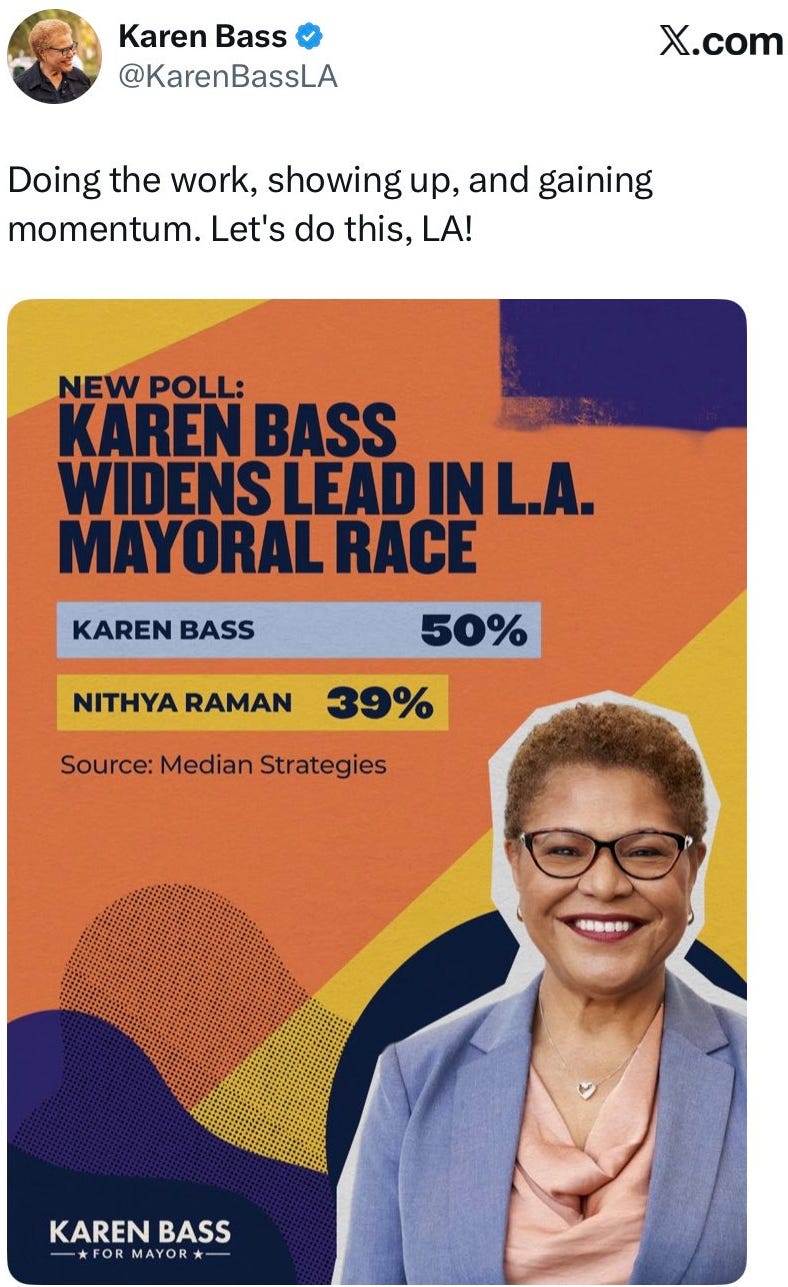
Meanwhile, The Public Sentiment Institute (TPSI), an outfit which has used synthetic samples, admitted to outright fabricating data by switching votes from one candidate to another. And that candidate just happened to be one they lied about working for.
cAnother fun tidbit: TPSI founder Lance Tellez is currently in felony pre-trial diversion in Miami-Dade County.
I’m not surprised it’s come to this. Two factors have come together to create this fake polling breakthrough:
Prediction markets create a direct financial incentive for manipulation. One “poll” of a thinly-polled race could move a market several points.
Generative AI makes it easy for these fake firms to cook up plausible-sounding websites and polling releases.
The underlying driver of all of this is an online political hobbyist class so thirsty for polls that they’ve tolerated a steady erosion in the quality of polling over the last several cycles just so they can get their data fix. This comes against a backdrop of rising costs driving many traditional media outlets withdrawing away from sponsoring high-quality polling.
As a result, the polls in any given race can range from costing a few hundred dollars to tens of thousands of dollars. More expensive polls tend to be more accurate, but they’re not 10 or 100 times more accurate than the cheapest ones. That means you tend to get a decent share of fly-by-night operators in the polling averages. A few wrong turns later — and a warped new set of incentives — and you get outright fabrication.
🗳️ Nate Silver is bullish on Dems
Nate Silver is out with his FLIPR model that’s more bullish on Democrats taking the Senate than the rest of what’s out there. I’ve written that I think it’ll be very hard for Democrats to flip many seats in Trump Country, but when Silver talks, I listen.
Silver also has a thoughtful response to my piece on Tuesday about summer polls overestimating Democrats. He and others have alluded to the fact that midterm polls under Trump have tended to be more accurate, but that’s only true at the end. During the summer, they are still too Democratic, as I show in this unlocked chart.
🔮 Prediction markets may just be the blind leading the blind
Fake polls can be used to manipulate prediction markets—but analysts are finding ways these markets are systematically biased against certain types of candidates where there might be decent alpha in betting in favor of them. (Note: As a pollster, I do not participate in prediction markets.)
First, Noah Wyhof-Rudnick finds a pro-incumbent bias in these markets, regardless of party.
The markets also appear to markedly underestimate female candidates — but only in Democratic primaries.
I used to be far more into monitoring vote drops on election night than I am now. But a couple of recent examples — the California and Wisconsin primaries — brought home for me just how unsophisticated traders were being on election nights. And the direction of their errors were all in favor of the progressive candidates.
In California, Election Twitter kept touting an unsustainable rate of improvement in late drops for Tom Steyer when the drops themselves were showing his base was too geographically narrow to be able to make the top two. But the spin helped his odds of making the top two rise to almost 50%, something I had pegged at a 10% chance at best. (Full disclosure: I was paying close attention since I poll for Steve Hilton.)
In Michigan, early drops gave Abdul El-Sayed a 99.9% chance of winning, but this dropped to as low as 90% as it tightened later in the evening. Some eagle-eyed Haley Stevens traders probably made some bank here.
In Wisconsin, Francesca Hong was trading at 74% when I concluded she had effectively no chance.
📈 The daily household costs that have risen faster than inflation
The Economic Security Project’s interactive dashboard shows the changes in economic pressures over time on the national or state level. While mortgages have only risen 3% since 2019, the costs of other everyday expenses tracked have risen far beyond the rate of inflation.
🍳 This is your brain on AI
Bruce Mehlman highlights EEG measurements showing that writing an essay with AI is neurologically comparable to drunk driving at twice the legal limit. While the quality of an AI-assisted essay probably won’t suffer, the impairment is also shown to compound and persist.


