


It was a few weeks ago that I wrote that polling over the summer hasn’t predicted the last few elections very well, overestimating Democrats. If we were to run an apples to apples comparison of data from that piece to polling right now, what would it show? Enter The Intersection’s 2026 Polling Index.
The polling index calculates the national political environment from individual race polls, broken out by House and Senate races. One advantage to this over regular generic ballot polling is that there tend to be many more individual House & Senate polls. The index now includes 450 polls: 165 House polls across 84 districts and 285 Senate polls across 26 states. This morning, it shows a 9.7-point swing towards Democrats from the 2024 presidential election results in the House and a 10.4-point swing in the Senate.
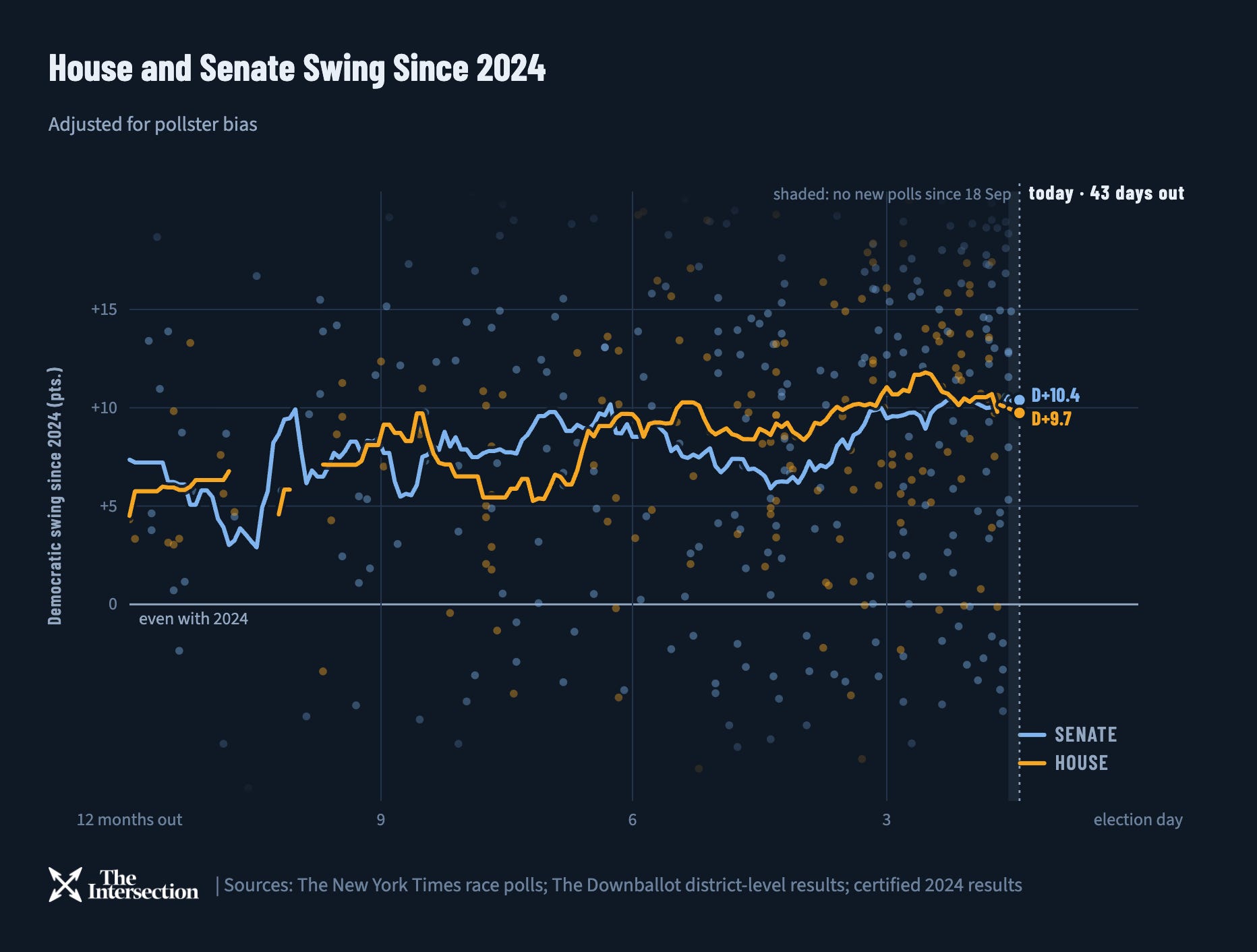
The political environments implied by both the House and Senate track closely together, with the Senate somewhat more Democratic than the House — and the House trending Republican while the Senate stays steady.
D+10.4 and D+9.7 are not the generic ballot, though. A couple of adjustments need to be made to convert them to a generic-ballot equivalent number.
First, polling this cycle has continued to show a bluer shift in redder seats, something I’ll discuss as a sign of potential polling error later. And because the tipping seats tend to be to the right of the country, they get polled more. So the first adjustment the index makes is to estimate the shift in a hypothetical seat that was Trump +1.5 in 2024 — the national average. This gets you a D+8.9 swing in the Senate and D+7.8 in the House. If you subtract Trump’s 2024 margin from this, this translates to implied generic ballots of D+7.4 in the Senate and D+6.3 in the House.
By comparison, this morning’s Swingometer shows the generic ballot nationally at D+6.9, right in in between these two figures.
Polling has stayed remarkably consistent over the last few weeks, with district-level House polling implying a slight turn in Republicans’ direction while traditional generic ballot polling seems to have shifted towards Democrats. Senate polling at this point in the cycle is lagging behind the swing Democrats were getting in polls at this point in 2018 but right around the 2018 final results. The midterm pattern of a late shift towards Republicans hasn’t materialized yet, but the data on this at this point in the 2018 and 2022 cycles was noisy. Polling from this point on in past cycles showed a clear shift towards Republicans. If that doesn’t materialize, that’s a bullish sign for Democrats.
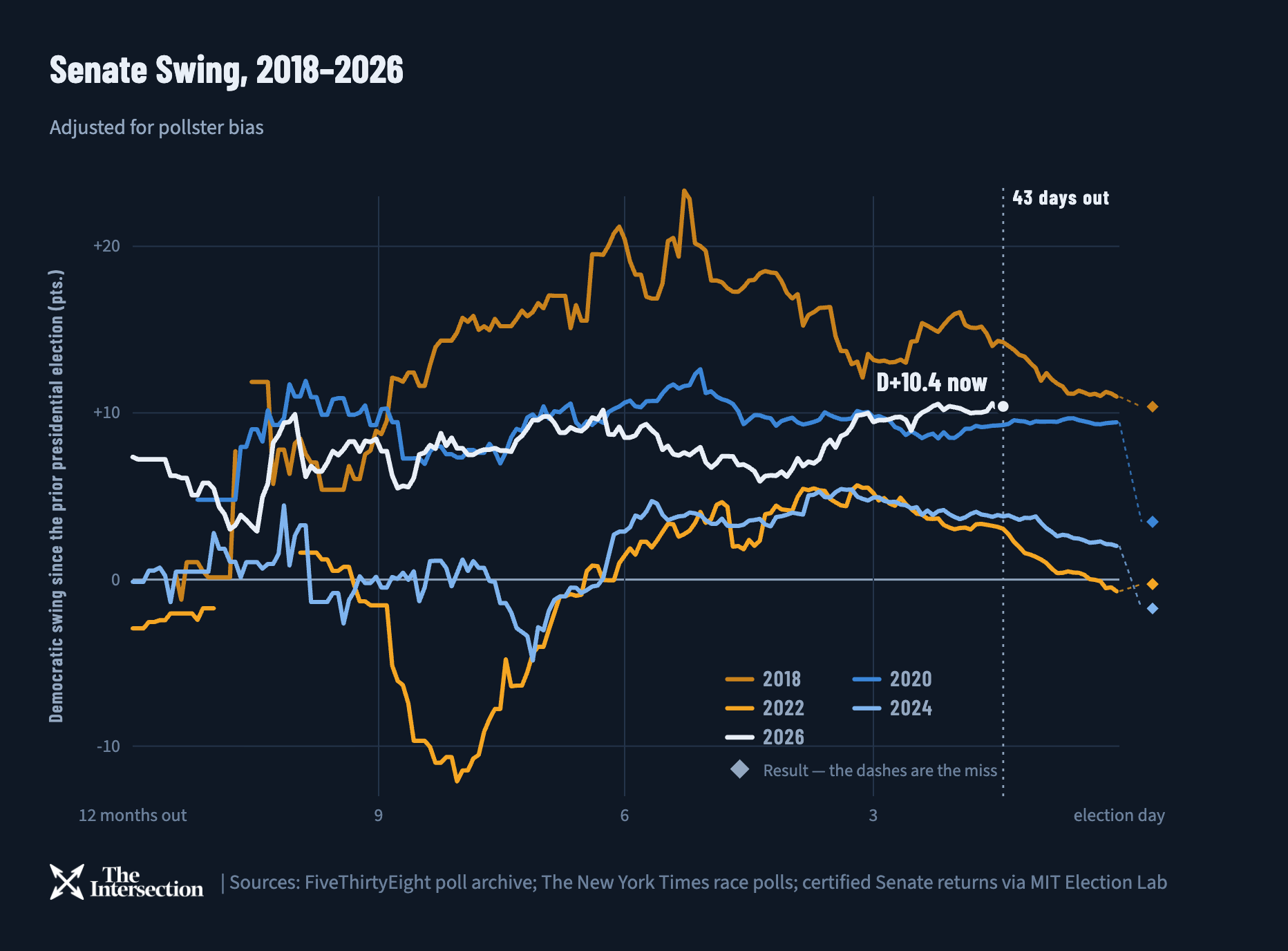
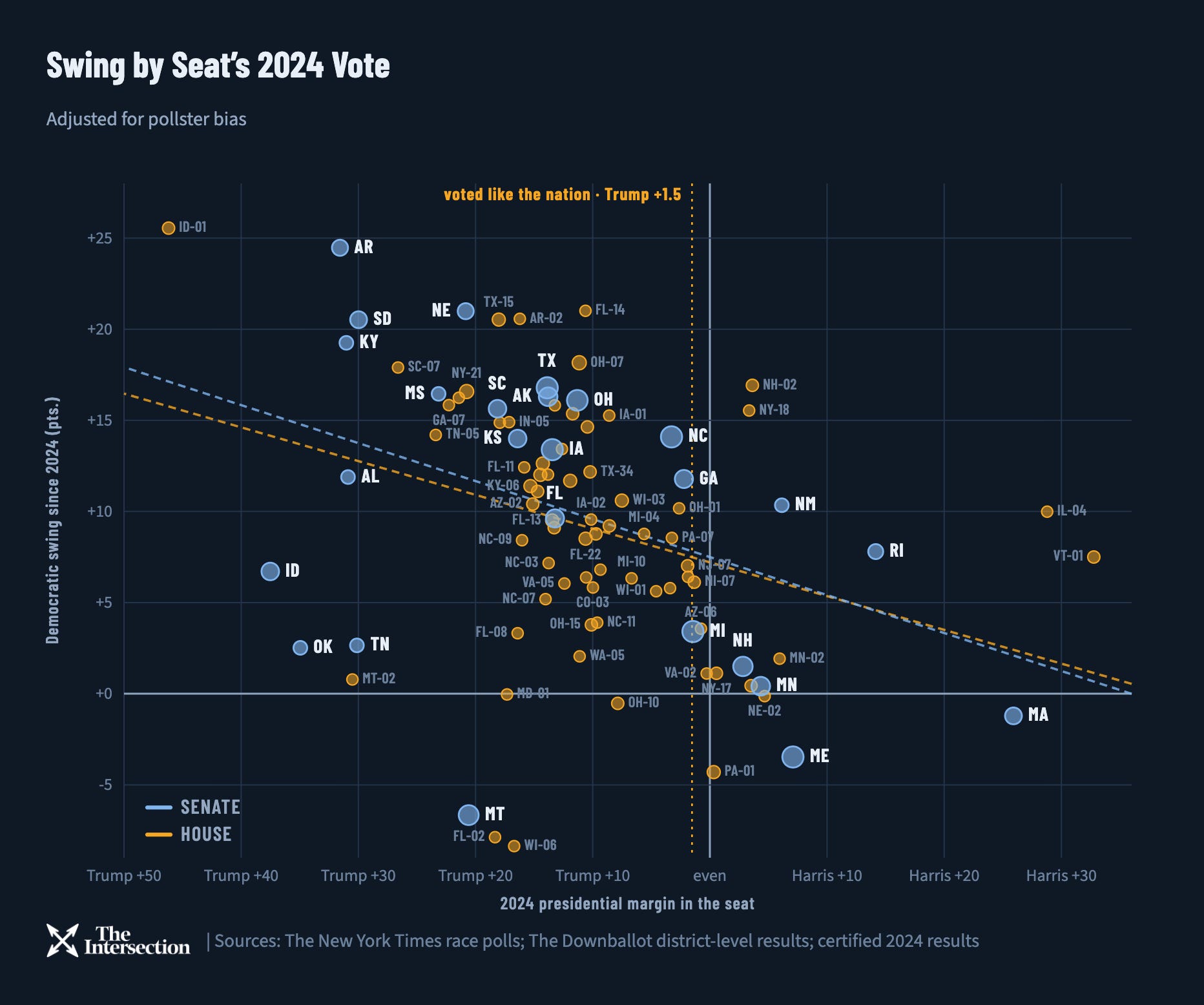
While there is no sustained move towards Republicans yet, one hallmark of past polling error is present in the 2026 data: Democrats performing better relative to 2024 in red-district polls vs. swing and blue districts. Here’s how the Polling Index tracks this:
This skew is currently exaggerated by Democratic polls designed to show tight races in both reach and traditional swing seats — a strategy to maximize Democratic fundraising detailed by Noah Wyhof-Rudnick. But it also holds for nonpartisan polls, which show 2 points of additional Democratic overperformance for every 10 points in additional Trump margin in a seat.
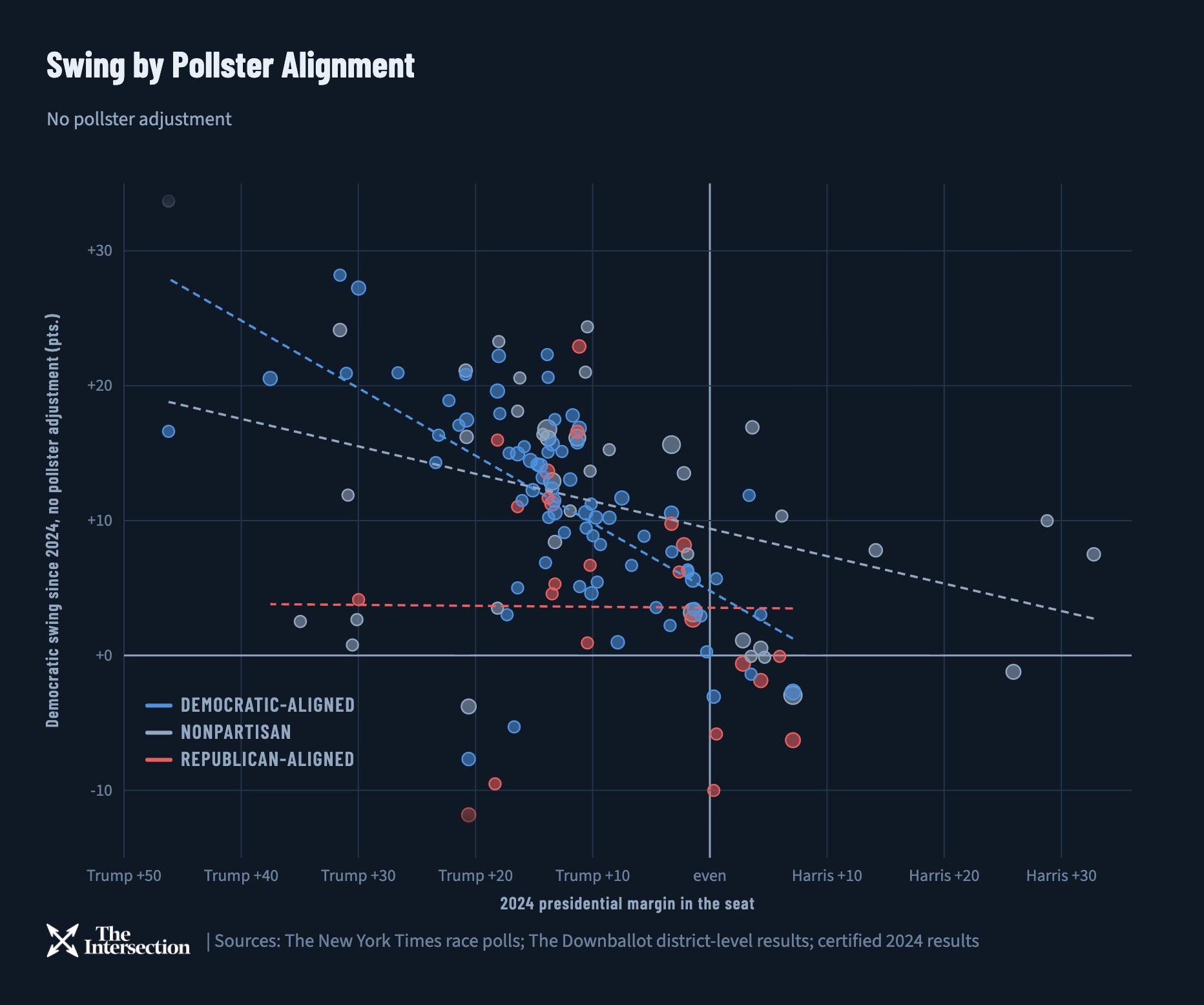
Because the majority of reported House polling are internal Democratic polls, and these polls seem to be deliberately showing close races regardless of partisan lean, a simple house effects adjustment isn’t enough. To the normal pollster house effect adjustment, I’ve added a Sandbagging Adjustment for Democratic seats that were close at the presidential level in 2024. The effect of this adjustment is to shift the House average nationally towards Democrats by around 0.5 points. The adjustment assumes that Democratic polls are releasing polls more favorable to Republicans in close presidential seats and adjusts them to make the relationship between Trump margin and 2024-26 swing look like nonpartisan polls. Pollster house effects are then applied. The net effect is to move the 59 House Democratic internals 2.3 points towards Democrats in seats between Trump +10 and Harris +5.
A red-state Democratic surge?
Do nonpartisan polls tell a different story?
We’re about to get a lot more polls
The Polling Index also tracks the number of Senate polls completing fieldwork in the preceding 30 days, compared with the last two midterms and the last two presidential cycles. The number of polls is about to tick up dramatically.
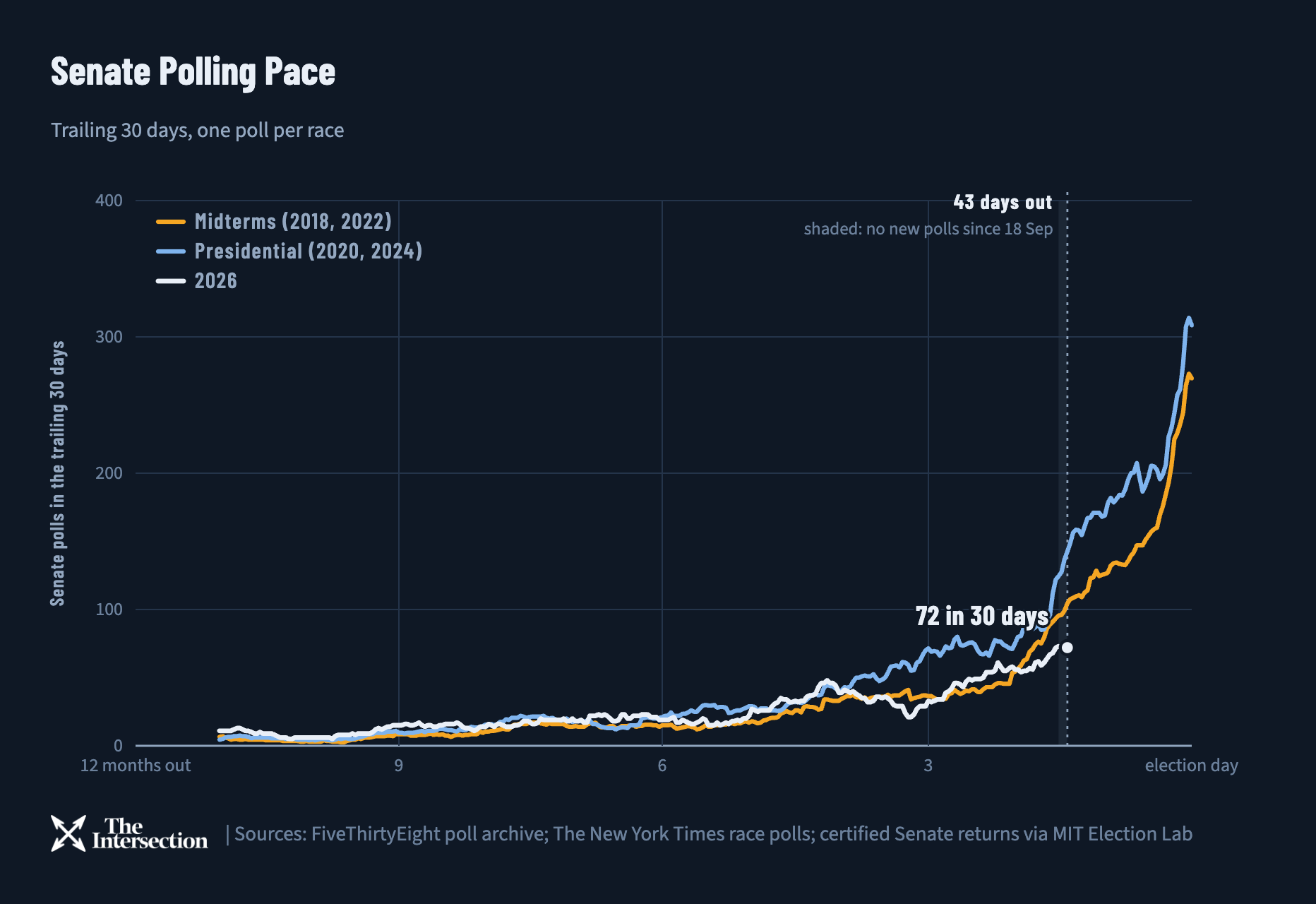
The fact that the 2026 line flattens out partly reflects yet-to-be-released polls at the end of the series. The current count is 72 Senate polls in 30 days, compared with 104 at this point in past midterms and 142 in presidential cycles. 2026 was tracking above the midterm average as of late August — which is a reminder of the lag that exists in releasing polling results. A newly released poll can describe an electorate surveyed days or weeks earlier. As more polls fill in, the Polling Index will retrospectively adjust the previous trendline in accordance with newly released polls that were in the field on a given day.