
The myth of MAGA isolationism
Polymarket insiders, the Claude Code moment, AI as the new crypto, the 2020s population race
No. 386 | January 9, 2026
🇺🇲 Why “America First” doesn’t mean what you think it means
The rise of Donald Trump was supposed to represent a break from the hawkish foreign policy that has defined the Republican Party since the Reagan presidency. Trump’s criticism of the Iraq invasion in the 2016 primaries heralded a new populist era where the GOP’s old foreign policy wisdom was thrown by the wayside. Many neoconservatives seemed to think so: they were the first to exit the GOP after Trump’s ascendancy and prominently endorsed Trump’s opponents, most prominently the late former Vice President Dick Cheney and his daughter, Liz.
And yet the first year of Trump 2.0 has been surprisingly Cheney-esque in its foreign policy: strikes on Yemen in the opening weeks of the administration, U.S. military strikes inside Iran, and now the capture of Venezuelan strongman Nicolas Maduro.
Republicans have rallied behind the operation, with support among MAGA Republicans stronger than non-MAGA Republicans.
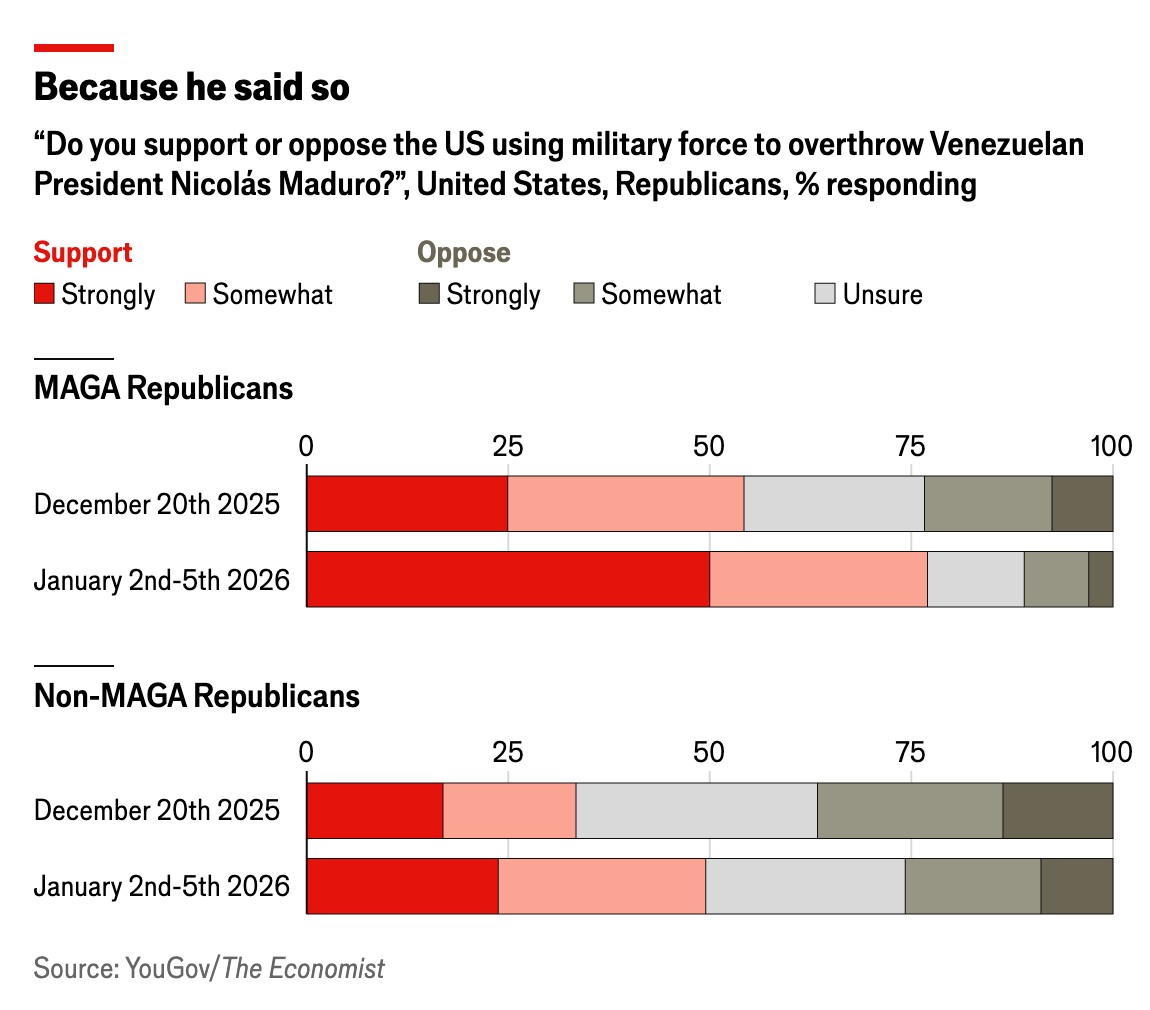
When military action in Venezuela is framed as an “invasion,” support among Republicans has more than doubled from when the question was first asked, to now almost three quarters of the party. It was once under 30 percent.
This is both an object lesson on the perils of polling future hypotheticals and a requiem for the rise of isolationism in the GOP. That idea is bound up in the branding of “America First,” a term first used in the run-up to World War II to keep the country out of war with Germany.
That idea has met the same end as the original version. We’ve gone to war, and war has (at least temporarily) proven to be more popular than first anticipated.
But the use of the terms “war” and “invasion” to describe what Trump is doing isn’t quite right. What Republicans — and voters overall — have rejected are long-term occupations of Middle Eastern countries where our troops were sitting ducks for terrorist insurgents. On the right, this was a rejection of a particular type of military intervention, not of military intervention writ large.
But the “boots on the ground” strategy was in and of itself a departure from the grand strategy pursued by Reagan and the elder Bush, which relied more on defense buildups and quick strikes. Ronald Reagan only sent ground troops into combat once: the 1983 invasion of the tiny island nation of Grenada. In 1989, George H.W. Bush invaded Panama to capture narco-dictator Manuel Noriega, a case very similar to that of Maduro. In that case, Bush placed tens of thousands of troops in an urban and jungle setting, the first major military operation since the fall of Saigon. At the time, there were fears of a repeat of Vietnam. And this was indeed what Bush would successfully overcome: a “Vietnam syndrome” that held that the U.S. military could not win major conflicts anymore. A year later, the successful Panama operation was followed up by an even larger lightning defeat of Iraq in the first Persian Gulf War. The American military was back.
Initially, the post-9/11 Iraq and Afghanistan conflicts followed this template, but the occupations that followed them were markedly less successful. That, specifically, was what Trump was responding to in 2016, not the quick in-and-out strikes profitably employed by Bush 41.
Language matters in polling — and it really matters in prediction markets — as disappointed Polymarket bettors found out when they wouldn’t be getting paid for predicting an “invasion” of Venezuela. The capture of Maduro was pulled off without a lengthy presence of U.S. ground troops. It was no more an “invasion” than the Osama bin Laden raid was an invasion of Pakistan.
When military intervention doesn’t require boots on the ground, the public is more supportive. And in contrast to the predictions of a “MAGA civil war” breaking out over Trump’s moves on Iran and Venezuela, MAGA stalwarts are wildly supportive. But even before Trump explicitly aligned himself with the hawks, the strongest Trump supporters were the voters most supportive of the projection of U.S. military power abroad. In that respect, the party has not changed from the time of Reagan and Bush: Republicans are still the hawkish party and Democrats are the dovish party.
What the party had retreated from is the 2000s version of nation-building and democracy promotion, which went sideways in Iraq and Afghanistan. But military action bound up firmly in the national interest remains as strongly a core Republican tenet as it ever was. Notice what Trump is not doing in Venezuela: he’s not installing the (pro-Trump!) democratic opposition and he is making it very clear that it’s about oil — something the foreign policy idealists of yore would have never copped to.
Fast forward to Greenland, where just 11% of Republicans favor a military invasion. Some pollsters may like to ask about this scenario, because it helps them find the white whale of Republican opposition to Trump. But Trump has so far achieved his policy aims in Venezuela and Iran without ground invasions, so it’s doubtful this would be the first resort here. But even if Trump did invade, do you think Republican support would stay at 11%? What about some sort of financial arrangement, the far likelier outcome. If Trump managed to bring Greenland into the U.S. fold without firing a shot, is there any reason to think Republicans wouldn’t be fully on board with it, with “America First” MAGA types the most in favor? I daresay that such an outcome would have a good shot at positive net support in the country as a whole.
The bottom line is that America First doesn’t mean isolationism: it means a foreign policy where we ruthlessly pursue our national interest and America comes out first against its adversaries. America First sentiment was always more hawkish than punditry has given it credit for. Cry your hearts out Tucker Carlson and Marjorie Taylor Greene.
On Polymarket, a newly-minted account 15x’d their money by betting on Maduro’s ouster just hours before the military operation.
And overnight, it seems like everyone has gotten into the game of detecting insider trading on Polymarket.
Watch for this as the next wave of financial speculation: people posing as whales making improbable bets that look like they come from insiders, only to dump the shares once momentum from copytraders pushes the price higher.
🤖 The Claude Code moment
RIP Stack Overflow, long live autonomous AI coding agents. Human Q&A about coding problems is going away, with queries on the once popular bulletin board dropping below its first month in business in 2008.
Stack Overflow itself is fine: it’s now making money licensing its back catalog to AI companies.
Anthropic’s Opus 4.5 model, which powers the most advanced use of the Claude Code platform, has once again accelerated the AI “time horizon” — how long it takes an AI agent to complete a task compared to a human expert with a 50% success rate — with those horizons now doubling every 4 months.
It’s not just for code: Claude Code wrote a wholly new empirical PoliSci paper in about an hour, complete with updated data, analysis, tables and figures, and a literature review.
📊 The AI coalition looks a lot like the crypto coalition
Who is most optimistic about AI? In a survey from David Shor, it’s young people, men, nonwhites. That resembles the crypto coalition a lot. And it’s also the coalition of new Trump voters from 2024.
👫 Winners and losers in the 2020s population race
Between 2020 and 2024, the lower Mississippi lost 5% of the population, and California lost 3.7% (over 1.47 million people), largely to areas in the rural north and the southern Sun Belt. Winners included the Texas Triangle of Dallas, Houston and San Antonio, growing by 3.5% in the 2020s. This map highlights unique regional clusters of growth and decline, with surprising gains in the Northwoods of the Upper Great Lakes and Rural New England.
Speaking of the Texas Triangle, here’s a cool video mapping Texas’ 13.5 million jobs down to the block level.


