


Amid growing discontent with the U.S. war in Vietnam, Richard Nixon on November 3, 1969 delivered his “great silent majority” speech, galvanizing anti-anti-war Americans to begin pushing back against the protests on college campuses. The speech was an unqualified political success, boosting Nixon’s approval rating by 20 points virtually overnight.
The phrase “silent majority” that derived from the speech is seen as marking a jumping off point for cultural polarization. But whatever version of polarization Nixon was cooking with was extremely popular, boosting his net approval to +47 points.
As a result of examples like this and those in the decades that followed, political reporters have been trained on the idea that a President’s job approval rating is highly responsive to the events of the day. Any fluctuation in these ratings however small must be due to whatever is in the news that week and definitely not random statistical noise.
I raise the Nixon example as evidence of the fact that presidential job approval is much less variable than it once was. There have been more recent examples of presidential approval jumping into the 90s overnight, but these involved the U.S. entering major wars. Nixon was able to engineer a 20 point bump just by giving a speech. The idea of Donald Trump — or Joe Biden or Barack Obama or Bill Clinton — doing this is laughable on its face.
Not only do modern approval ratings not fluctuate nearly as much, but their overall levels throughout a president’s term resemble each other more and more. Nate Silver’s postage stamp plot of approval of various presidents captures this pretty well. Donald Trump is now almost exactly at the approval rating recorded at this time during his first term — and Joe Biden’s only term. The approvals recorded by the last three individuals to hold the office are much more stable than anything that came before.
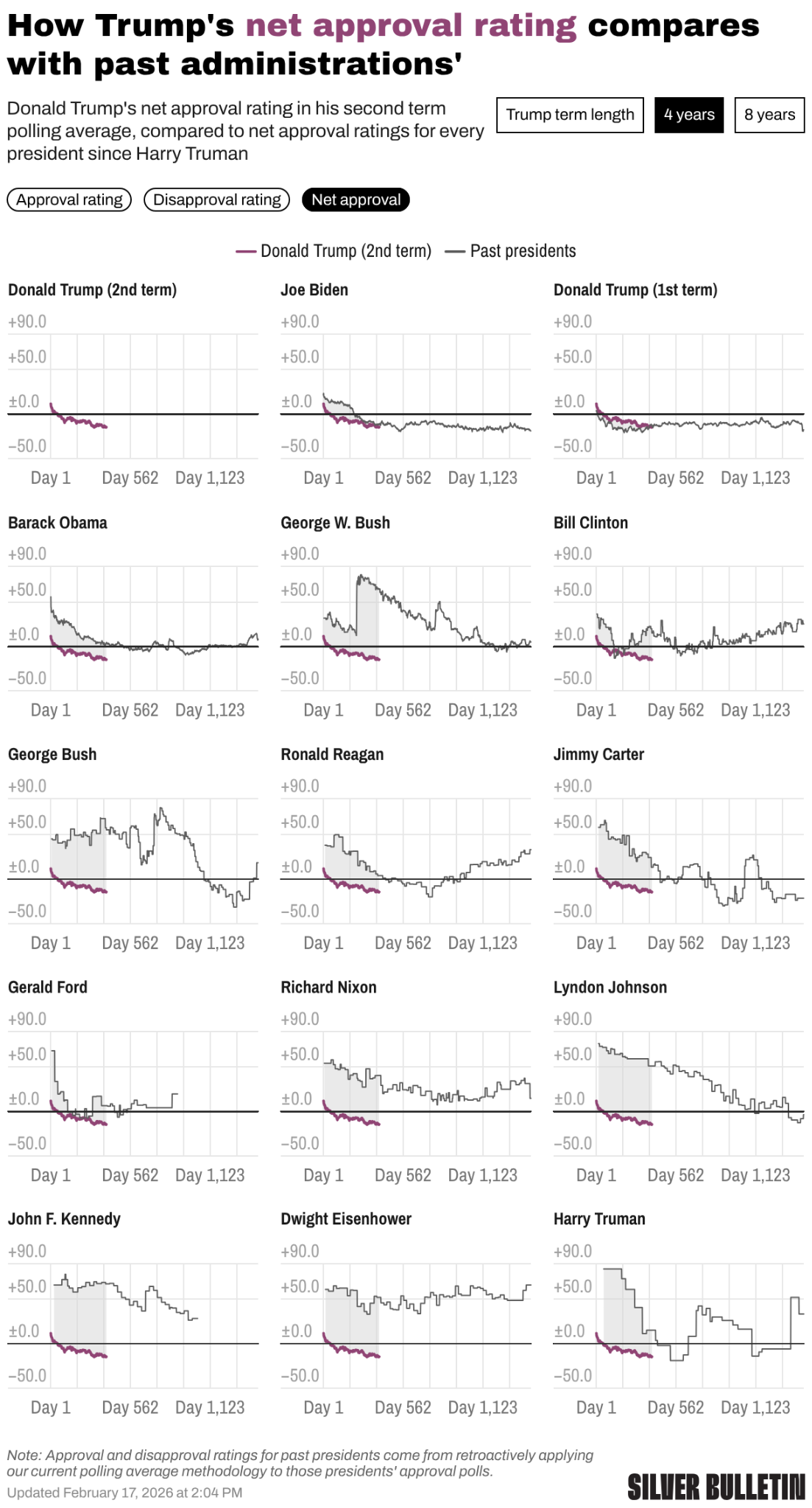
From this point forward in Trump’s first term, his approval was effectively a flat line, moving up by a few points during the initial Covid emergency, declining during the chaotic months that followed, stabilizing before the 2020 election, and declining after January 6th. The major crises of 2020 and 2021 only merited shifts of a few points in presidential approval.
One other feature of modern approval ratings is that they largely follow the same trendline over a four year period. There’s an initial honeymoon period that fully wears off sometime late in the first year or early in the second year — and the trend is mostly flat from there on out. Only during presidential re-election years do you start to see a slight uptick in ratings, as more voters begin to align their approval with their vote intent. But otherwise, the trend is flat throughout the entirety of a presidential term. And across the Trump and Biden presidencies, approval seems to be anchored in the low 40s.
With stability like this, we need to stop looking for event-driven explanations for presidential job approval and start looking at the forces that shape these numbers across presidencies.
