
American discontent
Gas prices x presidential disapproval, the happiness crash, unregistered adults don’t like whoever is in office, Craigslist and polarization, AI’s kitchen table boom
No. 397 | April 3, 2026
😡 America’s new age of discontent
Americans think the economy just plain sucks.
In 2024, you might have thought that electing Donald Trump would reset the public’s view of the economy back to what it was during Trump’s first term. After all, that’s people back then said they voted for. As I’ve noted before, there was reason to think this might work: economic perception rose sharply in the transition from Obama to Trump in 2016 and stayed pretty high throughout his first term—withstanding the shocks of the Covid pandemic.
That hasn’t happened this time.
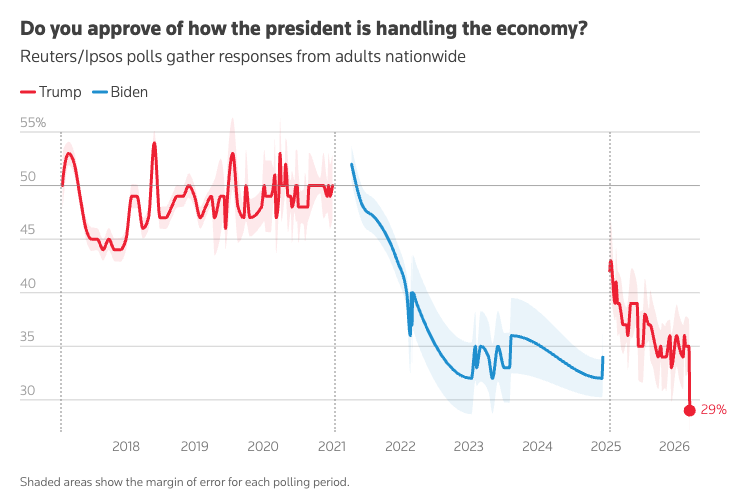
A Reuters chart of economic approval over the last three presidencies drives the point home. Economic approval did briefly recover on Trump taking office in 2025 and then it quickly reset back to Biden-era levels. In the midst of the Iran war, it’s nosedived to a new low of 29% in their polling.
Even if inflation worries eventually subside, it seems likely that AI job loss anxiety will be next as the main narrative driver for economic discontent. Though there’s no clear story to tell about AI driving any softness in the labor market, it’ll still doubtless be the next MacGuffin used to explain why the economy feels out of sorts.
In the short term, Iran constraining the world energy supply plays a bigger role. And gas prices have a psychological impact well beyond their actual impact on the overall cost of living. The relationship between higher gas prices and lower presidential approval is well established, as this new New York Times analysis shows.
But it’s not just the economy. The country has also experienced a happiness crash since the pandemic, one that’s touched all income groups.
Millennials are the ones reporting the least happiness and most economic concern, showing how the two measures — happiness and the sense that the economy is doing well — go hand in hand.
In 2024, economic discontent was manifest in a swing towards Trump among voters more at the margins of the economy. That wasn’t just a racial realignment, but a shift among young, single, non-college, and low-income groups.
These are also the groups swinging against Trump today because they are back to their Biden-era levels of economic pessimism. You can see it directly Trump doing worse in polls of all adults than registered or likely voters, a typical Republican pattern that was flipped around in the Biden era, but is now back.
Doing some simple math on Silver Bulletin’s approval averages of various kinds of polls, I built an admittedly crude but illustrative model of how different cohorts of the population view Trump. Unregistered adults, who are demographically similar to the voters that swung in 2024, are likely well under 30% approval. Even registered voters who are unlikely to vote are below likely voters in their support. But that doesn’t mean a low or even “normal” turnout in the midterms would save Trump, since his approval (today at least) is already below where it was in the 2018 exit polls.
How to break the country out of its post-pandemic funk isn’t just a political question for this White House. The country’s sour mood will greet whoever moves in next — in either party — and it extends well beyond politics. Any institution that depends on public trust is operating in a lower-trust, lower-happiness environment than it was five years ago.
Need an expert for your conference or fly-in to break down the midterms or the latest trends in politics, demographics, and AI? Visit my public speaking page or get in touch directly.
💥 What made us so divided
Blame Craigslist.
The rise of partisan media is a neat, tidy narrative for the rise of political polarization. But the causal mechanism traces back to the decline of local news as bulwarks of civic trust. A 2025 study in the Review of Economic Studies flagged by Tyson Brody, linked Craigslists’ entry into a city with newspaper job cuts and a decline in political coverage. And that decline, the study’s authors write, was associated with more partisan voting and more extreme candidates in Congressional elections.
If the first wave of the Internet made politics more extreme, could AI do the opposite? Findings reported by FT’s John Burn-Murdoch shows that the information presented by AI chatbots skews more toward the political center than social media. (Hey, if AI is producing boring uniform writing across the Internet, it stands to reason that it might also promote boring centrist politics!)
We’ll see if this lasts — or if the effect will be as advertised. After all, it isn’t “social media” that produced extreme content. It was users who liked and clicked on that content, and these are the same people using AI. Why shouldn’t we expect that they’ll eventually demand the same things from AI that they asked of social media?
🏠 AI’s biggest productivity gains might be at the kitchen table
Don’t just think of how AI might supercharge your productivity at work, but also at home.
A new study reported by the Wall Street Journal found AI super-adopters are getting productive tasks at home done faster — then spending the savings on leisure activities. Meet the people handing health insurance evaluations and doctor searches to AI and using the reclaimed hours for guitar lessons.
🗳️ IL-09: Age drove everything
While a liberal establishment candidate won the recent primary in the Chicago area’s 9th district, a VoteHub analysis found that young voters favored the activist left candidate with variance in age explaining almost half of the difference in her vote share. This follows a larger trend of young voters in both parties being more supportive of non-establishment candidates.


