
Four takeaways from the 2026 Political Tribes
Conventional wisdom is mostly right, one candidate's obsession with Israel, how redistricting shifted the tipping point seat, new VoteHub tool, the American mosaic
No. 408 | July 10, 2026
📊 Happy Tribes/Quadrants to all who celebrate
Echelon Insights’s 2026 Political Tribes came out yesterday. Built on answers to questions about social issues, economic issues, and trust in institutions, the tribes have been updated for 2026. The most left-leaning tribe gained five points, while other groups in the left and center fell.
As in previous years, we provide different lenses for uncovering the tribal alignments of American voters: the tribal cluster analysis, our political quadrants, and the multiparty democracy question we’ve run since 2019.
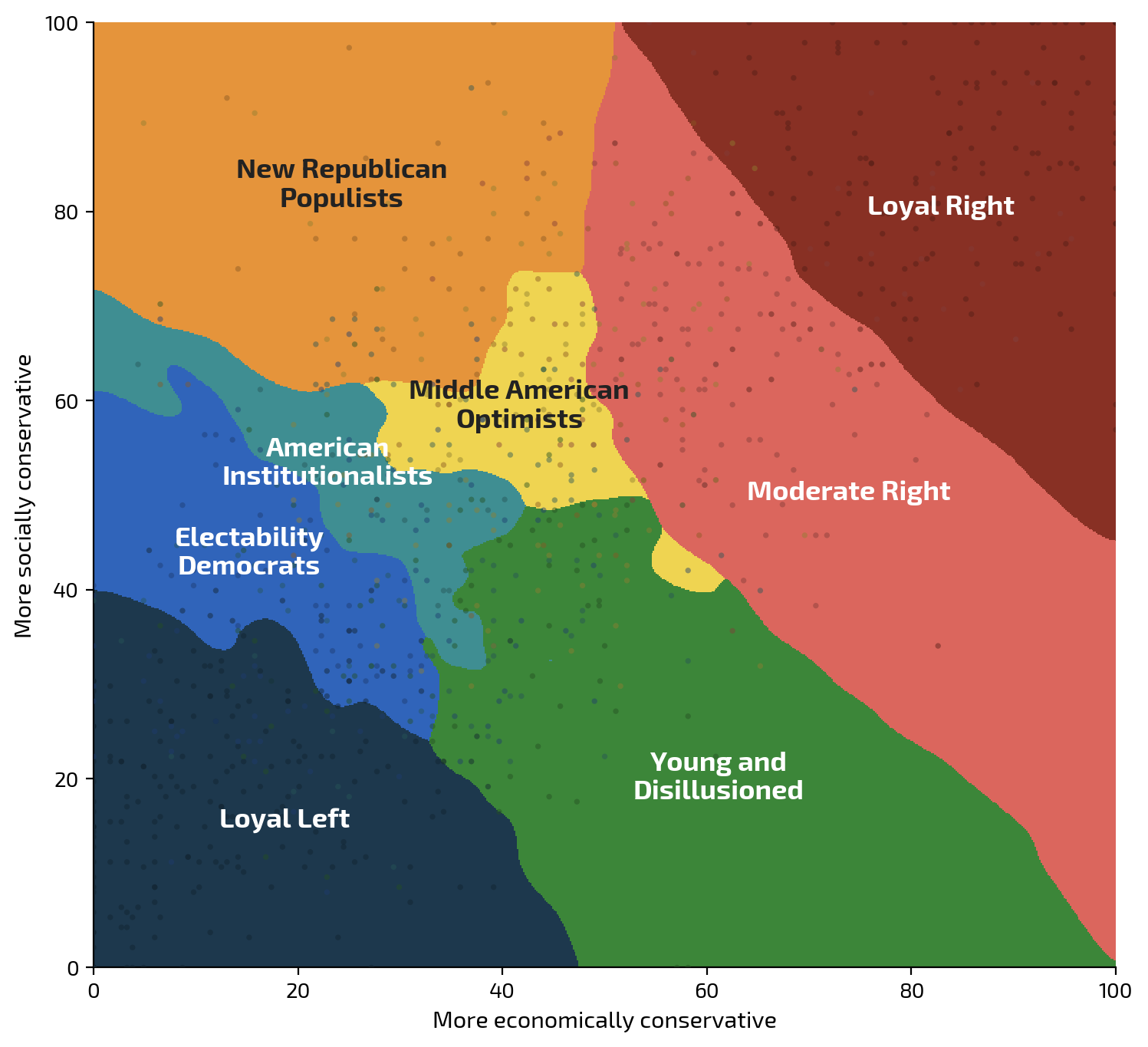
Before I get to some of the conclusions from this year’s study, I’ll put in another plug for the Tribes interactive feature on Echelon’s website, which includes 2D and 3D visualizations of the tribes, full quadrants data going back to 2021 with the ability to filter and isolate very specific subgroups, and for the first time, trendline data on all questions asked as part of the tribes/quadrants studies. If you prefer a more traditional deck, there’s that too.
Here’s what stood out to me in this year’s edition:
1. Thermostatic public opinion is driving the electorate left
The Loyal Left tribe went from 16 to 21 percent, mostly at the expense of the center-left. The Liberal quadrant of the electorate is up from 43 to 47 percent. The Labor Party went from 31 percent to 34 percent in our multiparty democracy test.
This growth is coming from center-left tribes like Electability Democrats, American Institutionalists, and the Young and Disillusioned. The primaries show Democrats in no mood for compromise, and that’s reflected in how the party rank-and-file is answering policy questions.
2. Immigration hawk populism has peaked
In 2024, voters were more likely to say that they wanted illegal immigration dealt with through more border security and enforcement by a 36 point margin (versus by making it easier to immigrate legally). That margin has collapsed to 6 points.
That’s the main evidence we have from our poll for thermostatic public opinion — that’s the tendency of the public to view the policies of the in-party as overreaching and to move in the opposite direction as a check. It may also be a reflection of Trump’s success in sealing the border. Whether this situation is a result of difficulties or success, Republicans no longer have immigration as a motivator to get their voters to the polls.
That’s reflected in other parts of our survey. The “Nationalist” Party, which has immigration enforcement as its lead policy, has dropped from 30 to 20 percent support in two years, and the populist quadrant — on the left economically and on the right socially — saw its first decline ever.
3. Meanwhile, economic left-populism continues to rise
A big result from last year’s poll was the decline of traditional economic conservatism, a function of discontent with the post-pandemic economy. While this stabilized in 2026, economic conservatism still sits at multi-year lows. This didn’t have the expected political valence during the Biden Administration, when voters were angry at Democrats for the performance of the economy. But now that Republicans are in office, it’s Democrats who can capitalize on this leftward shift, and that’s fueling the rise of socialist candidates in Democratic primaries.
4. The three political tribes tilting 2026 towards the Democrats
Let’s start with this chart, where a few interesting things stand outt:
Likelihood and motivation to vote in 2026 peaks at the ideological edges and is higher on the left than on the right.
Now, you don’t have to be particularly motivated or excited to vote in order to cast a ballot — that’s what the gap between likelihood and motivation is capturing on this chart.
But take a look at the gap in likelihood and motivation among the Moderate Right, which nicely captures your more culturally moderate non-MAGA Republican. They have the second lowest motivation to vote of any group. In a neutral political environment, they’d be behaving like Electability Democrats on the left, but their motivation to vote is 31 points lower. And our survey shows them shifting 14 points from 2024 to 2026.
That suggests the problem for Republicans going into the midterms is not discord on the MAGA right — it’s motivation and persuasion among Republicans NOT on the MAGA right, something Kristen Soltis Anderson wrote about back in May.
There are two additional groups where we see double digit shifts towards the Democrats, both of them potential swing groups: the New Republican Populists who are economically to the left and socially to the right, and the Young and Disillusioned, a more apolitical version of the Bernie Bro/DSA left, which swung towards Trump in 2024 but is now swinging to Democrats in 2026.
🤖 Conventional wisdom is mostly right
The Economist used GPT-5.5 to score 1,400 predictions from its leaders since 2000 and found a clear pattern: the closer a prediction hews to conventional wisdom, the more likely it is to be right. The publication’s biggest hits, such as warning early about the pandemic and the housing crash, were notable exceptions.
🇮🇱 Progressives like to talk a lot about Israel. Look who’s #1.
An analysis by Milan Singh in The Argument analyzes the content of Democratic fundraising emails and finds a telling divide: progressive insurgents talk a lot about Israel and AIPAC—much more than frontline candidates who rarely mention it at all—with some campaigns mentioning it more than half the time.
The number one spot is interesting—the erstwhile Democratic nominee for Senate in Maine. It’s really hard to imagine why Graham Platner would mention Israel/AIPAC more than any other candidate. 🤔
🗺 Redistricting shifts the House battlefield
The Downballot published updated 2024 election results for all congressional districts affected by mid-decade redistricting. The new maps tilt the median House district further toward Republicans. Before the redistricting push, the median seat was at Trump +3.1 in 2024. Today, it’s Virginia’s 1st district, at Trump +4.9. Either is winnable for Democrats in this political environment, suggesting a strong chance of a Democratic majority. The real story, as I’ve written before, is the lack of low-hanging fruit for Democrats beyond that.
🗺 VoteHub’s new campaign planner
VoteHub announced MapLab this week, a new tool that lets users model custom U.S. election scenarios by adjusting turnout, vote share, and demographics. The interactive platform is set to launch on July 15.
👫 The American mosaic
For July 4th, The New York Times published an incredibly detailed interactive visualization of American ancestry and identity.


