
The big partisan shift
The Liberal Patriot closes its doors, population winners and losers, no rallying around the flag, why young men aren’t getting married, the Virginia early vote, deadlines work
No. 396 | March 27, 2026
📊 Democrats no longer outnumber Republicans in the electorate
YouGov’s deep dive into the Cooperative Election Study — which has interviewed 60,000 Americans in every even-numbered year since 2006 — shows a consistent decline in the share of the electorate identifying as Democratic, now down to a near-even break with Republicans.
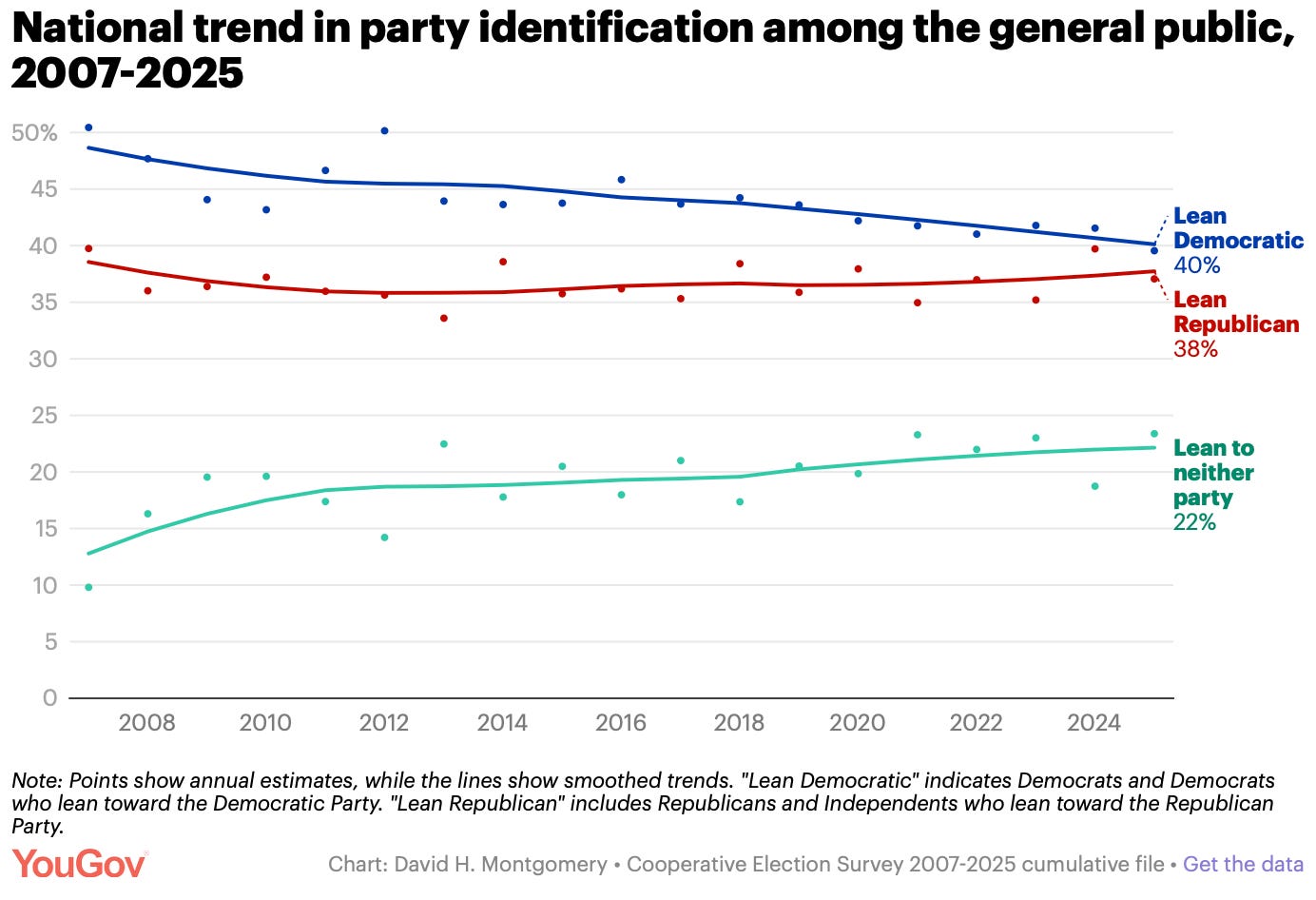
This is a trend I wrote about right after the 2024 election, except that in exit polls, Republicans actually outnumber Democrats and have since 2020. But it’s good to have a longitudinal dataset with solid subgroup breaks on party ID to do this analysis on. These trends by group confirm that the trend has been consistent across generations, with all groups getting more Republican as they get older.
And this also shows a clear shift among Black and Hispanic voters — with Black Democratic identification eroding in the post-Obama period and Hispanics shifting right since 2020. The fact that this shows up in Party ID numbers, not just voting intention, shows that some of the shift is not just Trump-specific.
And the data also captures the growth in Republican identification in less developed areas — the Trump 2016 realignment — that’s only deepened since then.
Need an expert for your conference or fly-in to break down the midterms or the latest trends in politics, demographics, and AI? Visit my public speaking page or get in touch directly.
🔵 The Liberal Patriot closes its doors in an age of hyperpartisanship
The shuttering of The Liberal Patriot is disappointing news for anyone interested in good faith cross-partisan discourse and for Democrats interested in solving the challenges just outlined above: declining identification with the party and losses with the working class and minorities. Ruy Teixeira delivers a parting shot titled “No Learning Please, We’re Democrats!” — arguing that the party is not only failing to learn from its losses but is increasingly insistent that learning isn’t even necessary.
That’s part of an emerging pattern: a DNC autopsy was promised and then shelved. Working class whisperers like John Fetterman found newfound relevance after the ‘24 election and are now pariahs in the party.
A lot of this likely has to do with a sense of optimism that the midterms will go well for the party and if they do that all of their problems from 2024 have been solved. As I wrote in “The midterm mirage,” that could give them a false sense of security. Midterms give out-parties a boost, in a Democratic-leaning year turning the country from the functional equivalent of Pennsylvania to the functional equivalent of Minnesota. Presidential elections bring out everyone and are increasingly a choice of whose culture people want to be a part of — red or blue America. Democrats have been increasingly losing that battle. Solving that problem means that Democrats don’t have to depend on the Trump administration being especially unpopular in 2028 to win.
Even if you think your party will do well in November, heterodox voices like The Liberal Patriot who stand athwart the hyperpartisan cheerleaders yelling “Stop!” are still sorely needed.
📈 Population winners and losers
The Census Bureau’s 2025 county population estimates are out. The patterns of growth and decline tell a clear story, not only about which regions are magnets for new growth, but about state-level policy.
The big winners in the 2020s:
The Mountain West — Utah, Idaho, western Montana
Florida
The Texas exurbs
Tennessee
The Atlanta exurbs
The Coastal Southeast — the Carolinas and Georgia
Upper South Metros — Richmond, Raleigh, Charlotte, Nashville
Where growth starts and stops at state lines tells you a lot about that state’s brand and their policy environment. At a state level, the biggest winners seem to be Florida, Tennessee, Utah, Idaho — and Washington State, as a blue state outlier with no income tax (though that’s changing soon). The losers seem to be Illinois, West Virginia outside the Panhandle, Louisiana, and California for losses in its big coastal population centers.
A widely circulated chart from Charlie Smirkley underscores the role taxes likely play in driving these migration patterns: the movers to red states tend to be higher in income, those to blue states lower.
📊 There is no rally-around-the-flag effect for Iran
Silver Bulletin has begun tracking approval of the Iran war — showing a further dip in support for the war in the last week.
🧑💼 Most young men want to get married. Here’s what’s holding them back.
What’s holding young men back from getting married? Among the young men (ages 18-29), only 16% are married. But a new survey by the Institute for Family Studies finds that the majority of single young men say they would like to be married someday. The reasons they aren’t often have to do with pessimism of the dating market, with economic reasons being a powerful secondary factor. 44% say it’s “hard to find the right person to marry,” 36% are “not ready for the commitment,” and 1 in 4 cite the lack of a stable job.
🗳️ Competing storylines about Virginia’s referendum turnout
Virginia voters go to the polls on April 21 for a constitutional amendment on redistricting. Despite the fact that the election was scheduled at a time when no one usually votes, turnout seems quite high. State Navigate finds a correlation between increased early voting turnout compared to the 2025 and red areas: cc
But Kyle Kondik points out that the modeled partisanship of early voters is exactly the same as it was in the very Democratic 2025 election — but all caveats about modeled partisanship apply here.
🏃 Marathon finishing times show that deadline deadlines work
The distribution of marathon finishing times clusters dramatically around round-number cutoffs — 3:00, 3:30, 4:00. The takeaway: deadlines and goals work — even if they’re somewhat arbitrary.


