
The fight over abundance and scarcity
Redistricting Advantage: GOP, new midterm forecast, neighborliness on the decline and so too are births, the perfect time to buy a house
No. 401 | May 8, 2026
🏭 The new politics of American business
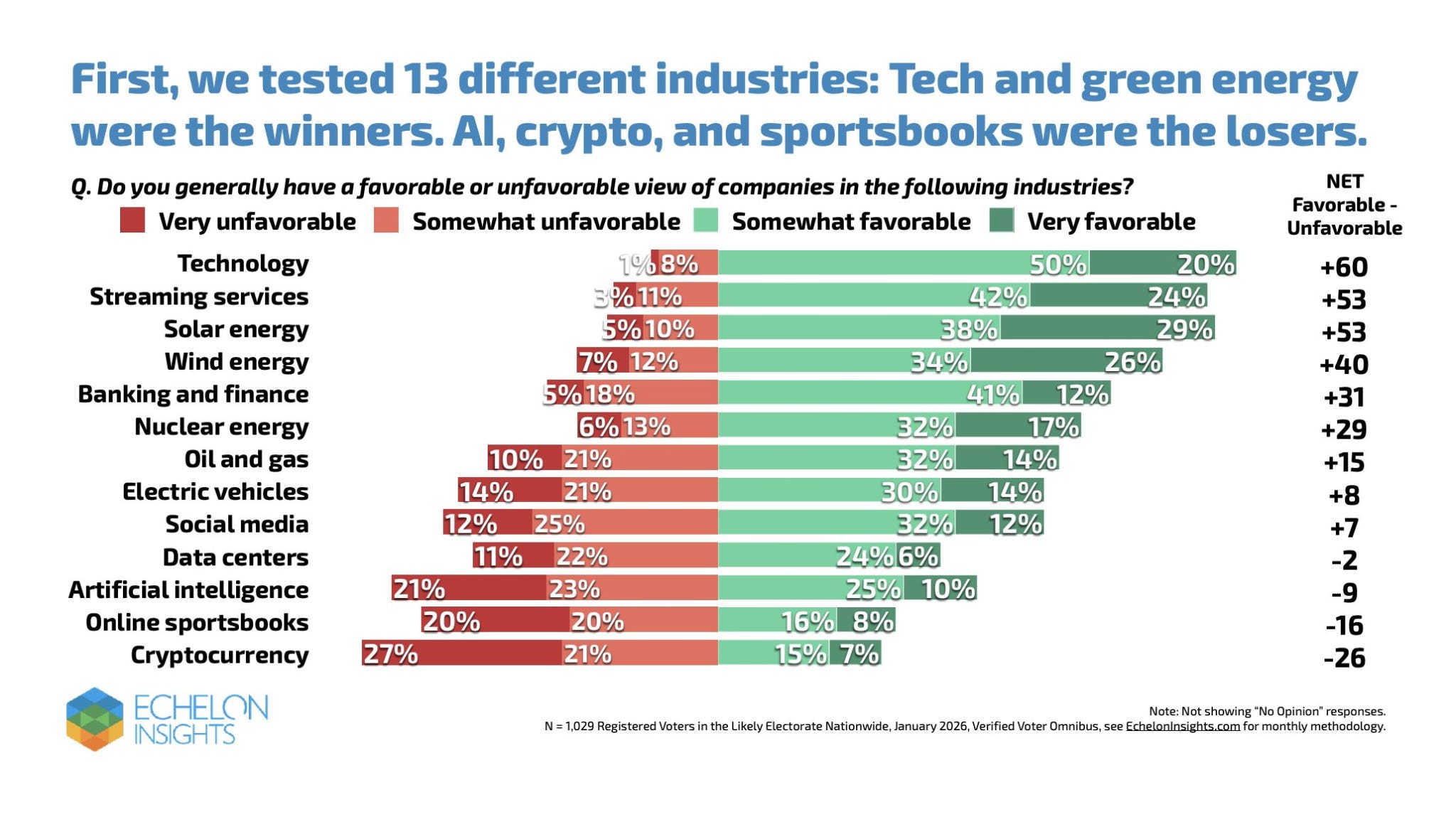
The team at Echelon released a report this week on the voter coalitions supporting and opposing 13 key industries. You can download the full report here.
Applying our political tribes framework to views of American business, we found 7 “tribes” with distinctive belief systems that guide their support or opposition to various industries. We think these are pretty revealing about the dueling impulses within each of the major coalitions, and also about the mindset of conflicted swing groups. Here are what those tribes look like:
The political right is dominated by two tribes: the Anti-Green Right (17%) and Center-Right Abundance (17%). The Anti-Green Right is made up of traditionalist voters who make active distinctions between different industries — preferring fossil fuels to renewable energy. They are populists, holding a negative view of banking and finance while the population overall holds a positive view. Center-Right Abundance is positive towards every industry, taking an “all of the above” position towards every energy source.
While the majority of the “abundance” conversation has been on the left, tellingly, it’s the Center-Right Abundance tribe that outnumbers the Center-Left Abundance tribe, 17-12%. Center-Left Abundance is what you’d expect — optimistic towards green energy and most technology. They’re also the most left leaning tribe, and pretty bro-ey, at 59% male. But they’re outnumbered by their counterparts on the right — and there are limits to their acceptance of different industries, holding very negative views of oil & gas and are tepid on the AI buildout.
The other main group on the left are Old-School Greens (10%), who hold positive views of wind and solar energy only, opposing all other industries including clean technologies that require industrial-scale deployment, which includes both electric vehicles and nuclear energy. These are your Berkeley NIMBYs.
More in the center are three groups: Aggressive Deployers, Trump +4, who hold positive views of basically everything and are very young, male, nonwhite, and currently in the workforce, Industry Pragmatistics, Harris +4, a senior-heavy group that actively distinguishes between “proven” industries which it favors and speculative industries which it opposes, and Passive Youth, Harris +23, a (not exclusively) young and female-heavy group that’s largely favorable to new technology and green energy but leans against fossil fuels, AI, data centers, and crypto.
You can break down the tribes into a cross-cutting Abundance and Scarcity factions in the electorate, which break down about evenly 42-39%, with Passive Youth sitting in the middle. Abundance and scarcity are cross-cutting groups within each political coalition — showing why the old left vs. right playbook doesn’t work in fights over frontier technologies.
🚨 Virginia redistricting struck down — GOP wins the battle, but will it win the war?
With last week’s Callais decision, I wrote that Democrats may have run out of good redistricting moves. Today, the Virginia Supreme Court struck down the referendum enacting a 10-1 Democratic gerrymander. The court did so on procedural grounds, holding that the manner in which the referendum was put on the ballot wasn’t legal.
Not only do Democrats get at least 3 additional seats wiped out, but this casts doubt over the entire strategy the party was using to push back against the GOP redistricting assault — special referenda in blue states to override nonpartisan redistricting commissions.
No other Democratic state has moved to redistrict, and in just the last two weeks, two Republican states have — Tennessee and Florida, with more on the way. Without nonpartisan redistricting commissions on the books, Republicans in those states have been able to move swiftly and clinically to zero out Democratic seats.
This leaves Democrats with few good options: go back to the voters in these states to completely repeal nonpartisan redistricting or push forward with extreme gerrymanders that zero out Republican districts in California and Illinois. They won’t have the opportunity to do this before the midterms, and the next chance they get will be in a much less Democratic-leaning year.
Regardless, none of this changes the basic trajectory of the election cycle, where Democrats are still favored to win the House — although Republican redistricting moves from here on out can make it closer.
Pre-Virginia ruling, VoteHub released their 2026 forecast — which includes precinct-level estimates (!) — showing Democrats with an 85% chance to win the House. That obviously changes with the latest rounds of redistricting, but my quick breakdown of this has Democrats gaining 15 seats above the net 2 they were forecast to gain from redistricting. There’s no world in which Republicans could gain a further 15 seats from redistricting alone.
Zachary Donnini did a breakdown that shows Republicans’ odds increasing from 15% to 28% under their best redistricting scenario, now very much in play. I do think the underlying model is a bit bullish for Democrats, for instance, negating most of the Republican seat gains in Florida. But Democrats are still favored for 2026 — even if the current map will cause them huge headaches in any kind of neutral political environment.
📉 The decline of everything good, part 94,202
Neighborhood engagement is on the decline with younng Americans who talk to their neighbors at least a few times a week falling from 51% in 2012 to 25% in 2025. Most Americans, particularly young adults, think good neighbors mind their own business. Neighborhood engagement rises with age, education, and regular worship — but it’s down among older generations too.
U.S. March births have fallen by 1.75% since 2025. Further tempering the expected demographic transition, when nonwhites become a majority of the U.S. population, the declines have been greatest among the Black and Hispanic populations. Some have chalked this up to deportation policies in Trump’s second term.
🏠 When are you better off buying a house?
Redfin provides their data on the housing market across the U.S. free of hassle and charge via their Data Center, leading to insights like these: July - September is the best time to buy a home, with the most new listings and the most concessions from sellers.


