
The incredible shrinking swing seat
Black turnout rose post-Callais, what Dems need in the House & Senate, special election eras, rethinking Latinos, Echelon trends, defining the elites, free markets over capitalism, the Jones Act
No. 410 | July 31, 2026
🗺 How redistricting is shaping 2026
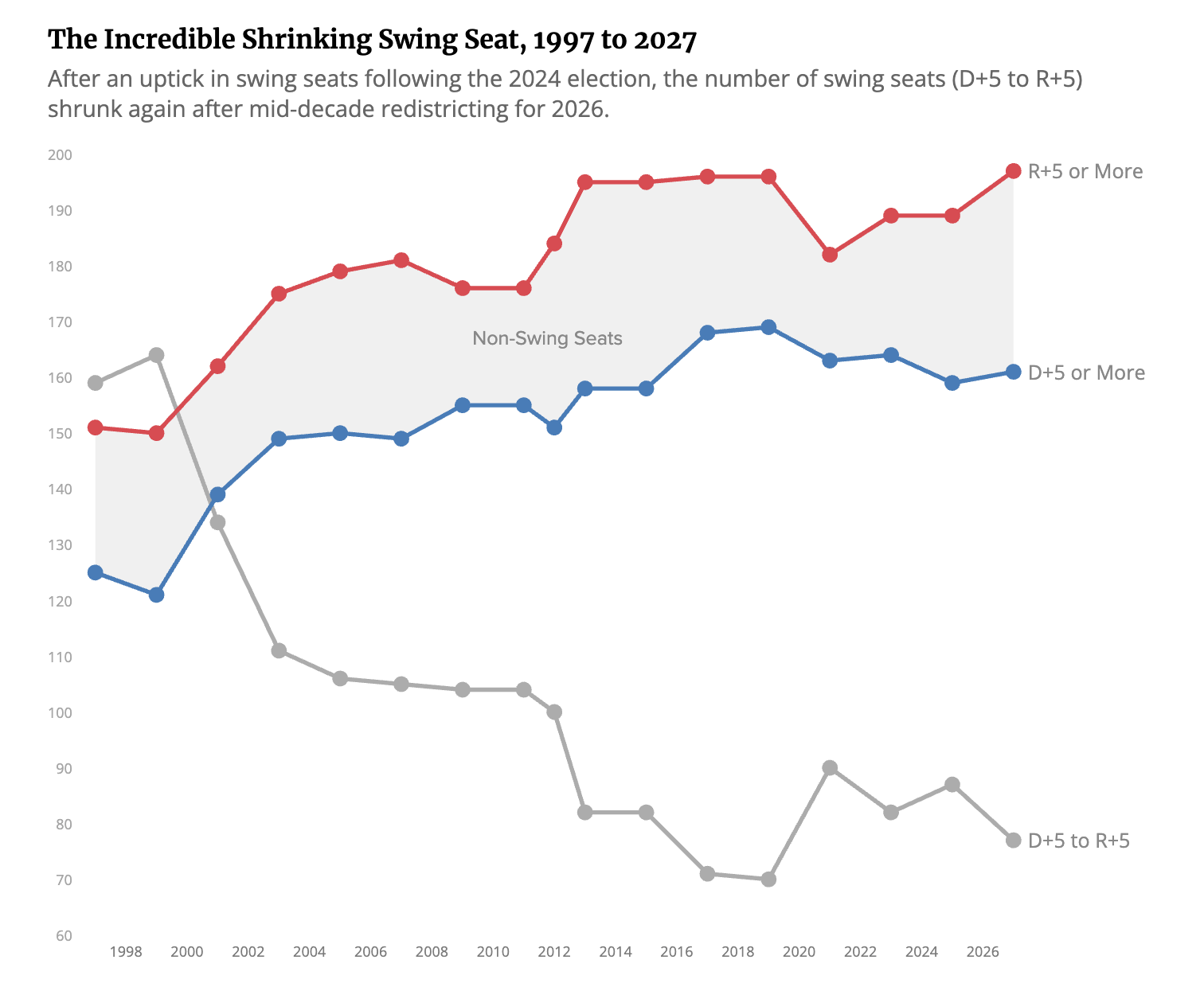
It’s a theme that we’ve returned to again and again: only a handful of seats will decide control of Congress and with this year’s re-redistricting, districts have been purposefully engineered to reduce the number of seats Republicans need to spend money defending.
Cook Political’s new PVI ratings are out showing relatively safe Republican districts (R+5 or more) as an all-time high, Democratic safe seats inching up, and swing seats plummeting. As we’ve said before, it’s not about taking Democratic seats and making them Republican. It’s about taking swing seats and making them Republican. But swing seats aren’t fully dead yet: Realignment post-2020 increased the number of competitive districts; swing seats in the Cook formulation were at an all-time low after 2018. But they did take a hit with this redistricting cycle, plunging them near Trump 1.0 lows.
One response to redistricting was that Black voter turnout surged in Southern primaries following the Supreme Court’s Callais decision, VoteHub’s Ellis Bates writes. Across four Black Belt states, majority-Black counties outperformed statewide turnout by 5.9 points on average – more than five times the gap seen in pre-Callais primaries.
This was mirrored in high Republican turnout in Virginia’s redistricting referendum. Taking your party’s seats away is a powerful turnout motivator, as are all threats to your partisan identity coming from the other side, a negative case against Democrats I’ve argued Republicans need to amp up if they want to avoid steep midterm losses.
Speaking of maps, The Downballot is out with their “hexmap” which resizes every House district to the same size. By preserving actual state shapes, is a slightly more palatable version than those abominable cartograms where you have no absolutely no idea which states you’re even looking at.
🇺🇲 Midterm waves
This is a cool application of VoteHub’s forecast data showing exactly how generic ballot margins translate to the parties’ chances of winning control of each chamber. Democrats need to do about 4 points better to win the Senate than the House, but the Senate is higher-variance because there are fewer races.
🗳️ The eras of special election overperformance
Another analysis from The Downballot finds seven distinctive eras of overperformance in special elections. What’s interesting is that while they still do signal midterm waves, the recent cycles show that they may no longer be reliable in predicting the national baseline. Democrats had special election overperformances heading into the 2022 midterms, and while they overperformed in that midterm, Republicans still won the House popular vote. Likewise, Democrats had a special election edge at the end of the 2024 cycle and the election went in the opposite direction. Current specials seem to indicate a strong Democratic baseline combined with secular overperformance stemming from having a more educated electorate.
🔵 Rethinking Latino voters
Equis Research, authors of those famous post-2020 Latino vote postmortems, didn’t do one post-2024 but is instead launching The New Dynamic, a new effort to better understand the dynamics of the Latino vote.
This comparison of Trump’s Latino approval from his first to second terms is revealing. Trump’s approval ratings have crashed with this voting bloc since the start of his term, something that didn’t happen in 2017-18. But there’s a question of whether Trump’s higher ratings earlier in his term represent something of a new baseline. As the Equis team writes, Trump has given back some of his gains with Latinos, but Republicans’ standing might still be higher than it was throughout much of Trump’s first term.
📈 Explore six years of Echelon data
Echelon Insights’ new interactive Trends tool allows users to track public opinion across six years of omnibus surveys. Select a metric, break it down by demographics, and see how opinion has shifted over time.
💰 Who are The Elites?
Who do Americans think the elites are? According to a new poll from The Argument, the left-wing definition of billionaires and business wins out over the right-wing definition of the professional class, the media, and academics. The right-coded answer that gets the most traction is celebrities. The Hollywood Elite lives!
💳 “Free markets” over “capitalism”
Matt Yglesias writes up our latest polling data showing Americans, especially young Democrats, view a “free market economy” much more positively than “capitalism.”
🛳️ Track the Jones Act waiver in realtime
The war in Iran is spawning a policy experiment free marketeers have been clamoring for: a rollback of the Jones Act limiting shipments between U.S. ports to U.S.-flagged vessels. The Cato Institute has a very cool dataviz showing nearly 200 voyages since March covering over 50 million barrels of oil.


