
The myth of the Trump-only voter
When no one votes Democrats win, redistricting a wash, 40% of young women would leave the U.S. if they could, scary AI progress, the rise of the long-range kicker
No. 383 | December 5th, 2025
đ The myth of the Trump-only voter
Readers will be shocked to learn that I think thereâs a media narrative about recent elections that doesnât get it exactly right.
This is the idea that Trump voters will only show up for Trump, and not for regular Republicans running in off-year elections.
Iâve covered the unfolding turnout problem for Republicans in depth. I wrote that the Virginia elections were consistent with 80% of Harris voters voting and 70% of Trump voters voting. In TN-7, I think this was 60% of Harris voters and between 45% and 50% of Trump voters â lower in the rurals, higher in the suburbs.
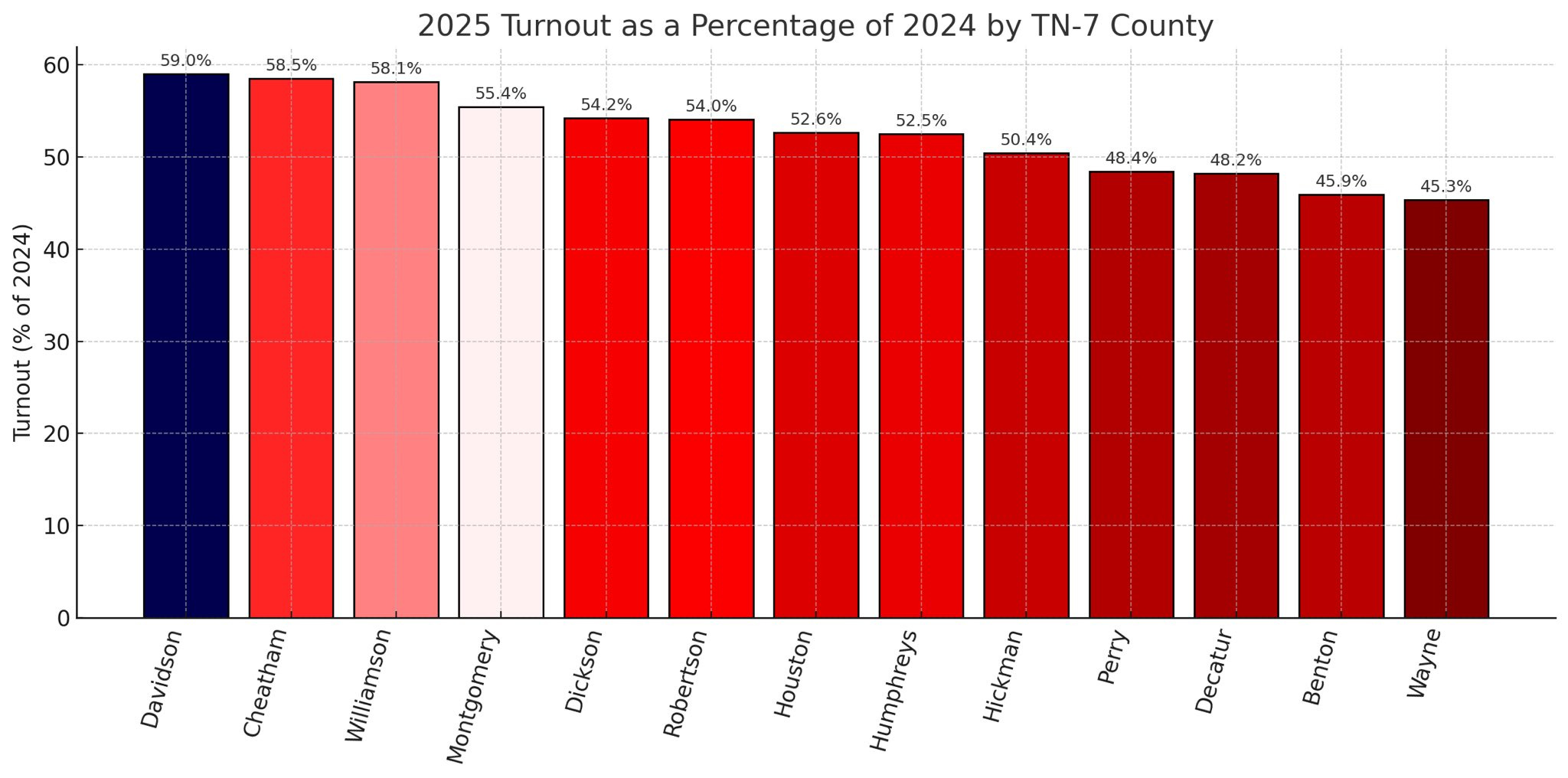
Turnout in deep-blue Nashville outpaced rural red areas in TN-7 â thanks to ChatGPT for making this chart off of a couple of screenshots of NYT election results
But this is also normal midterm turnout dynamics at play. The Virginia numbers were an exact mirror image of the 2021 turnout, where the pattern was almost exactly reversed from when it favored Republicans. Trump voters had no problem turning out to vote for Glenn Youngkin.
In all our years studying the idea of a âhiddenâ or âshyâ Trump vote, weâve never found evidence of a voting bloc completely invisible before that showed up to vote just for Trump â and which stayed home for other Republicans. To the extent turnout has risen in the Trump era, itâs been a rising tide lifting all boats: lots of new Trump voters, but also lots of new Democratic voters. The net effect has been something of a wash.
When I looked at turnout after the 2016 election, the rural turnout where Trump surged was pretty much as expected; the surge was lots of people switching from Obama to Trump, not new voters. The same was true in 2020, when Trump surprised people by making it close. Nor has turnout dropped off inordinately in these areas in Trump-voting areas in midterm elections. Overall, turnout was quite strong in ruby red areas in 2022; the problem that year was persuasion in Biden +0 to +5 target seats.
Trump voters in these areas will sometimes ticket split in favor of local Democrats. But thatâs different than saying they arenât voting. In the Trump era, youâve had ticket splitting work both ways, with Republicans outrunning Trump in suburbs and running behind him in rural areas and with realignment voters. Over time, these gaps have shrunk as everything has gotten more nationalized.
People went so far as to claim that in 2024, Trump voters came out for Trump and then left downballot races blank. Of course, people vote in all different combinations, so we canât say this never happens. Looking at the cast vote record in places like Nevada, some percentage of Trump voters did do this, but it was nearly offset by Harris voters who did the same. The large majority of the GOP underperformance in the Senate race was due to voters who voted for Trump and then voted Democratic for Senate. Persuasion is always a more powerful driver of vote shifts because one voterâs choice simultaneously subtracts one vote from one side and adds it to the other. Undervoting only subtracts.
Another aspect of this urban legend is itâs the most hardcore MAGA types doing this. Nope. Hardcore MAGA types are also hardcore conservative Republicans who reliably vote in elections. As I wrote in the âlow propensity voter theory of everything,â itâs not these voters who are defecting from Republicans. Itâs irregular Trump 2024 voters who also happen to be swing-voting independents.
To win a presidential majority, you need to win the bulk of the fickle, Presidential-only voters who decide in October or later. The downside of this is that these voters are then not available to you in lower turnout special and midterm elections. They either donât vote, and those who do vote are more apt to swing back.
This is a known problem. Barack Obama won two presidential victories fueled by low-propensity voters and struggled mightily to turn these same voters out in midterms. More than 1,000 Democratic state legislative seats were lost during his tenure.
Thatâs the basic bargain of modern politics: win the presidency and then start losing. But the presidency is still plenty worth it: you get to wield executive power in increasingly creative ways, and if youâre a Republican youâre backstopped by a conservative Supreme Court. You get to run foreign policy. You are the Keeper of the National Vibes, wielding cultural power and commanding attention than random Senators and Representatives can only dream of.
In a definite vibe shift, Democrats are now +5 on the Congressional generic ballot. My spidey-sense is that this is pollsters adjusting to the reality of a Democratic-friendly turnout, which was brought home by the Virginia-New Jersey elections. Weâve been transparent about the fact that if you back-weight our previous polls to our new 2026 turnout model, you get something closer to a 5-point margin than the previous 2-point average polling margin.
A must-report from Eric Wilson finds that Democrats outperformed Republicans in the recent election on digital competence and both major and small-dollar donations, reaching voters through a stronger ecosystem of websites, email, and social media.
The more turnout goes down, the better Democrats do.
TN-7 is consistent with this. It wasnât that close in the end, albeit still a solid Democratic overperformance, because Republicans did more to juice turnout than in other specials this year.
đşď¸ Redistricting as incumbent protection
Re-redistricting looks like more and more of a wash, though the possibility of a Democratic win is much-reduced with SCOTUS saving the GOPâs Texas maps. Even with Texas, Zachary Donnini finds that the window where redistricting actually flips the House majority is extremely narrow, happening at somewhere around D+1 in the popular vote. At this point, thereâs little difference between a redistricting cycle with Texas and the old maps.
The biggest difference is that the new maps would save a number of Republican incumbents in a strong Democratic wave.
đŁď¸ 40% of younger women would leave the U.S. if they could
This is certainly a new twist on the youth gender divide: 40% of young American women want to move abroad permanently, quadrupled from 10% a decade ago, and 21% higher than todayâs young men, the widest gender gap Gallup has ever seen on this subject. Among younger women, desire to leave the country is much higher in the U.S. than the OECD average.
đť Torrid AI progress, for good or ill
In a story that definitely hits close to home, LLMs are making it cheap and easy for bad actors to
skew online survey results across disciplines, which affects polling as well as academic research. Dartmouth political scientist Sean Westwood demos an agent that can fill out convincing responses to open-ended attention checks.
NotebookLM can now make pretty decks from academic papers with no hallucinations.
Researchers have found ways to increase an LLMâs persuasiveness in conversations with voters by as much as 51%. They find that information that comes across as factual is most persuasive, but those âfactsâ donât necessarily need to be truthful.
đ The rise of the long-range kicker
Field goal attempts over 55 yards have increased by 300% since 2022 â and the rate at which these attempts are made has climbed even more.


